
Weather Doesn’t Slow Down. Your Building Does.
Cooked, stretched, baked, frozen, and torn at the corners. Northwest Indiana hands a flat roof several seasons in one day. And the next level of chemistry just arrived to take it.
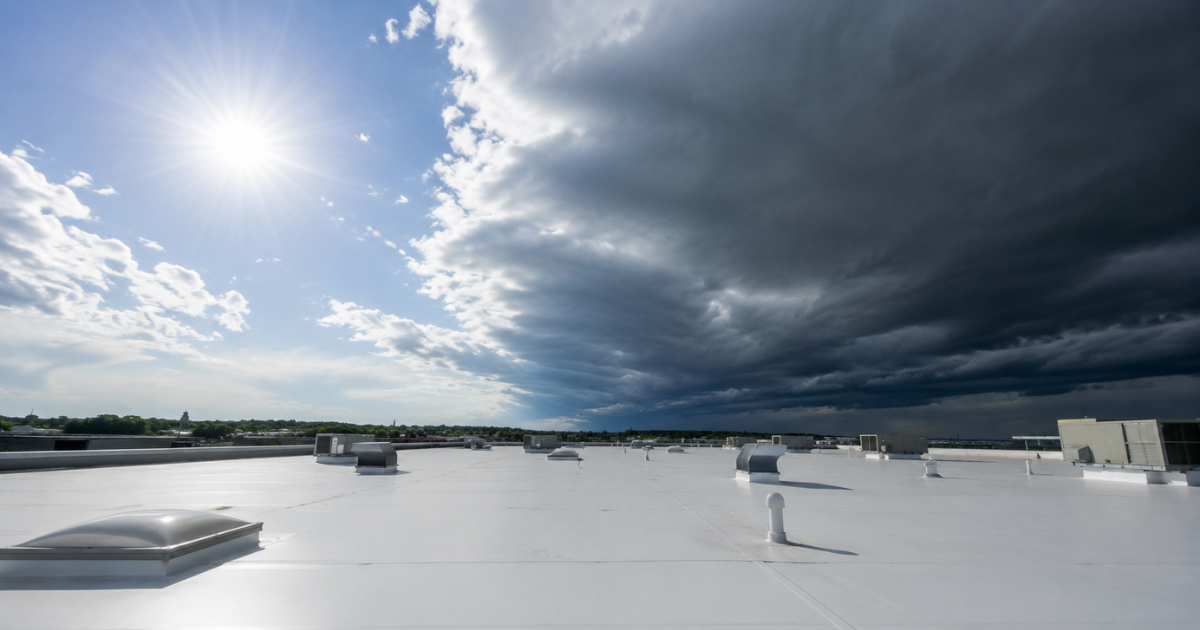
🔲 80% of roof damage starts at the corners and pipes. Our system wraps them into one seamless surface.
🔲 No seams. No welds. No glue. No rolls. One continuous, fabric-reinforced surface, applied right on your roof.
🔲 Built to flex through Northwest Indiana's freeze-thaw cycle. Heat, cold, and wind stop finding weak points.
🔲 20 years covered, then a topcoat refresh resets the clock. Maintained every six months, fully documented.
Here is the part nobody tells the building owner. The weather is not the problem. The roof's reaction to the weather is the problem.
Northwest Indiana hands a flat roof several seasons in a single day. Hot, then cold. Calm, then a wall of wind. The sky keeps moving at full speed. The roof has to stand still and take all of it.
Frequently Answered Questions
Q: Does a tornado damage a roof even when the building is still standing?
A: Often, yes. Wind can lift edges and stress corners and seams without taking the whole building. The damage is real even when it is invisible from the parking lot. Get it looked at after a storm.
Q: Why do flat roofs fail at the corners and the pipes first?
A: Those are the spots where wind gets a grip and where the roof has to work around an obstacle. About 80% of roof danger lives in those zones, not in the open middle.
Q: Can temperature swings really crack a roof?
A: Yes. Heat grows the material and cold shrinks it, every day, for years. Older materials get brittle from that cycle and finally split. A seamless reinforced system is built to flex with it instead of fighting it.
Q: Is a seamless roof actually better than one with seams?
A: A seam is a joint, and a joint is the most common place a flat roof leaks. Remove the seams and you remove the most common failure point. That is the whole idea.
Q: What is the strongest choice for a high-wind area?
A: A continuous, fabric-reinforced surface that wraps the corners, the edges, and the rooftop pipes into one piece, so the wind has nothing to pull up. That is the system we install.
Q: How long does the seamless system actually last?
A: Twenty years of scheduled upkeep, then a topcoat refresh that resets the clock for another twenty. The reinforced core underneath is built to stay in place through more than one refresh cycle.
Q: Does this work on a roof that already has old seams and patches?
A: Yes. That is the point. The system wraps over existing seams and fasteners, ties them together with reinforcement, and turns the weakest part of the old roof into part of one continuous surface.
The roof gets cooked, then stretched, then baked, then frozen
A flat roof lives through more abuse in a year than most people think.
It gets cooked. Summer sun bakes the surface for hours. A dark roof can run far hotter than the air around it, and that heat does not stop at the surface. It works its way down into every layer underneath.
It gets stretched. Heat makes the roof grow. Cold makes it shrink. Every single day the material is pulled one way and then yanked back the other way. Multiply that by hundreds of days a year and you start to understand why a roof that looked fine last Spring is suddenly leaking this Fall.
It gets baked. Years of that heat slowly drives the life out of older materials. They get stiff. They get brittle. They lose the give they were born with. A material that used to flex with the building now fights it instead, and something has to give.
It gets frozen. Water finds a small opening, freezes overnight, and grows. Ice is a quiet wrecking crew. It widens the opening every time it freezes, then melts, then freezes again. By the time Spring arrives, a pinhole can be a real problem.
None of that is dramatic on any one day. That is exactly why it gets ignored. It is a slow leak of strength, and you do not see it until you see the water on the floor inside.
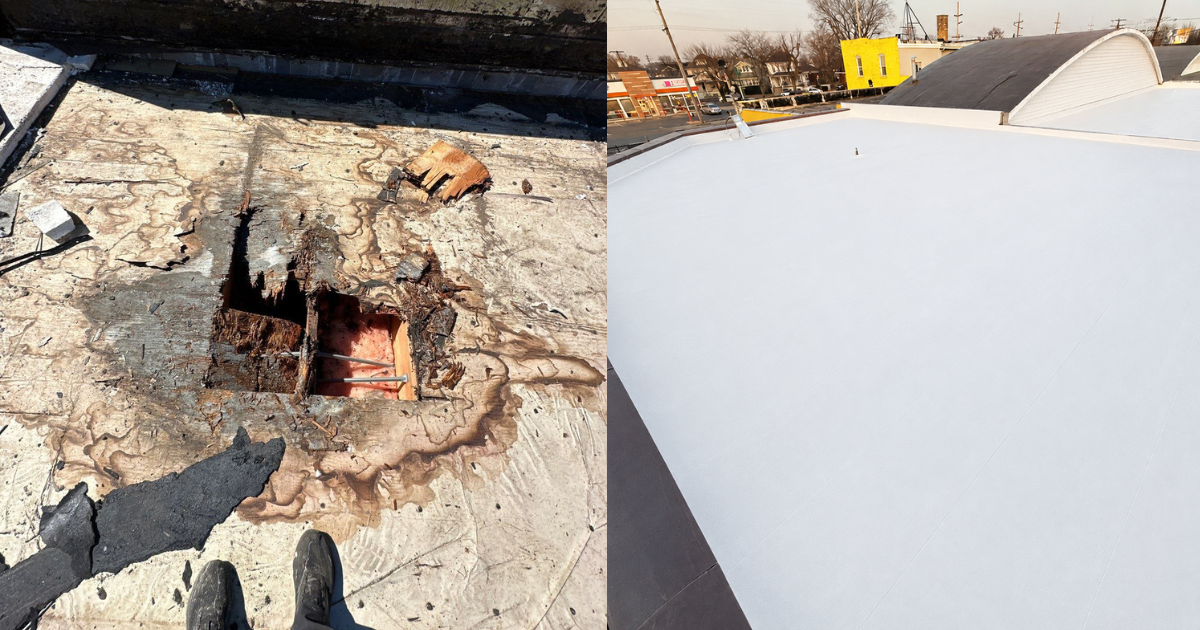
And then there is the wind
Wind is the one that does the loud damage.
A tornado does not push on a roof in a straight line. It swirls. It curls. It reaches under the edges and pulls up. Wind does not look for the strong middle of your roof. It looks for the weak corner and the loose edge.
About 80% of roof danger lives in the corners and around the pipes.
Not in the wide-open middle. At the edges, the corners, and the spots where things stick up through the roof.
That is not bad luck. That is physics. The corners and the edges are where the wind gets a grip. The pipes and the curbs are where the roof has to stop and start around an obstacle. Stops and starts are where seams live. Seams are where roofs come apart.
Think about it the way a building owner would if they walked the roof after a storm. The middle of the field looks fine. Nothing lifted, nothing torn. But walk the perimeter, check every pipe boot and curb, and that is where you find the lifted edge, the peeled corner, the seam that has started to separate. The wind already told you where it was going to attack. Most roofs just were not built to listen.
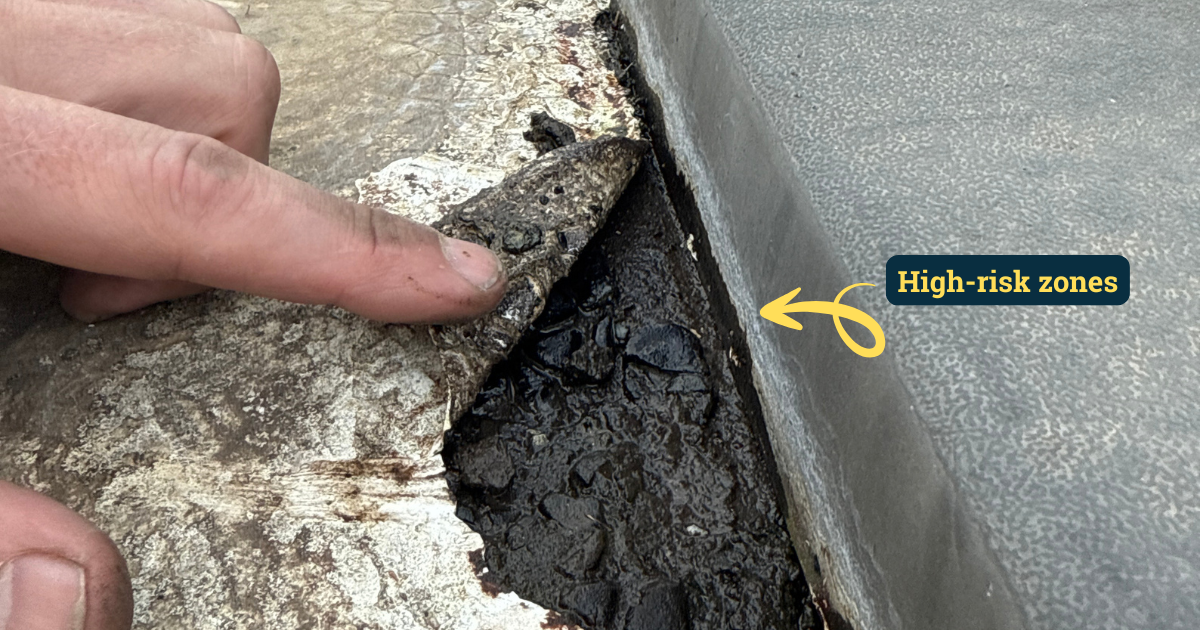
Seams. Welds. Glue. Rolls. The weak points we removed
Most flat roofs are built from large sheets. Sheets have edges. Edges have to be joined. Every joint is a seam, and a seam is a promise that two pieces will stay married for twenty years through every freeze and every windstorm.
That is a lot to ask of a glued line.
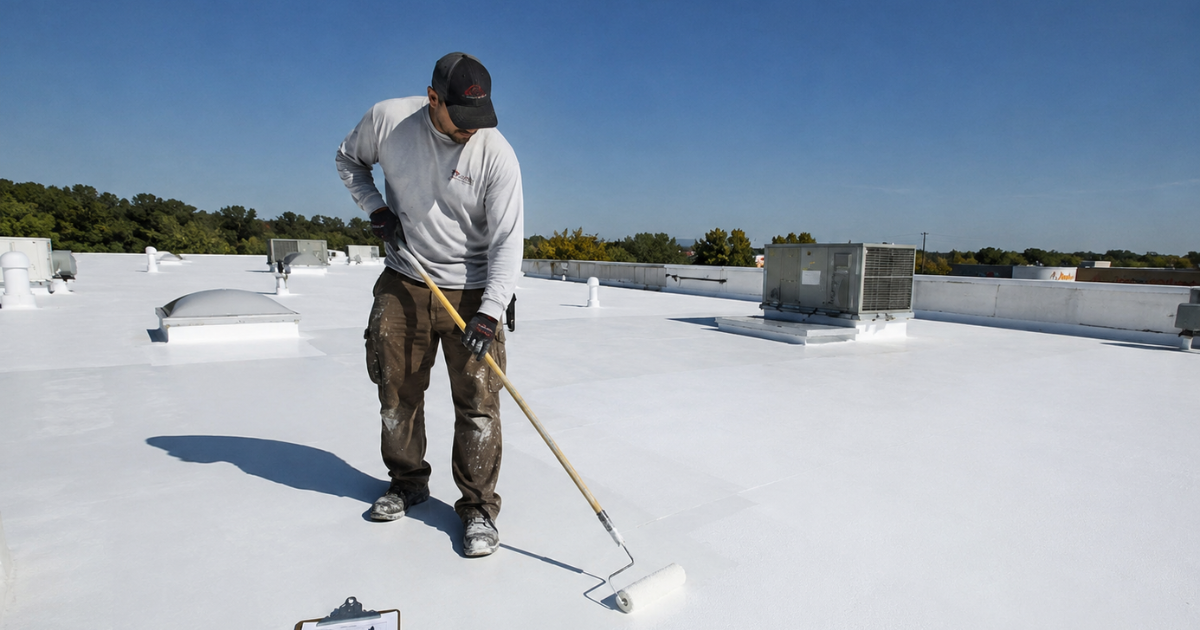
So we stopped asking. We do not roll out sheets and join them. We build the roof as one continuous surface, wall to wall, with no seam to come apart.
We bake the cake right on your roof.
No more seam. No more welding. No more glue. No more rolls.
Picture the six-layer cake
Picture a six-layer cake built right on top of your existing roof. Liquid goes down, fabric reinforcement goes in, and more layers lock over the top. When it cures it is one piece. There is no joint for the wind to grab and no seam for the ice to pry open.
The process starts with prep, and prep is where a lot of shortcuts get taken on cheaper jobs. The surface gets cleaned and decontaminated. Old buildup gets blasted off. A gripper primer goes down so every layer after it has something honest to bond to.
Then the base coat goes on, acrylic or urethane depending on the roof. Then comes the reinforcement, a spun flex mesh laid into every old seam and around every fastener, tying the whole roof together and giving it stretch it never had before. Then another base coat layer locks that reinforcement in at roughly a millimeter and a half thick. Then a reflective topcoat finishes it off at close to two millimeters, the layer that faces the sun every single day.
Plenty of frosting. Solid foundation. Resilient stretchy inside. That is the cake we bake, and it is baked in place, not shipped in rolls and hoped into position.
The corners get wrapped. The edges get wrapped. The pipes and the curbs get wrapped right into the same continuous skin as the rest of the roof. The 80% danger zone becomes the strongest part of the roof instead of the weakest.
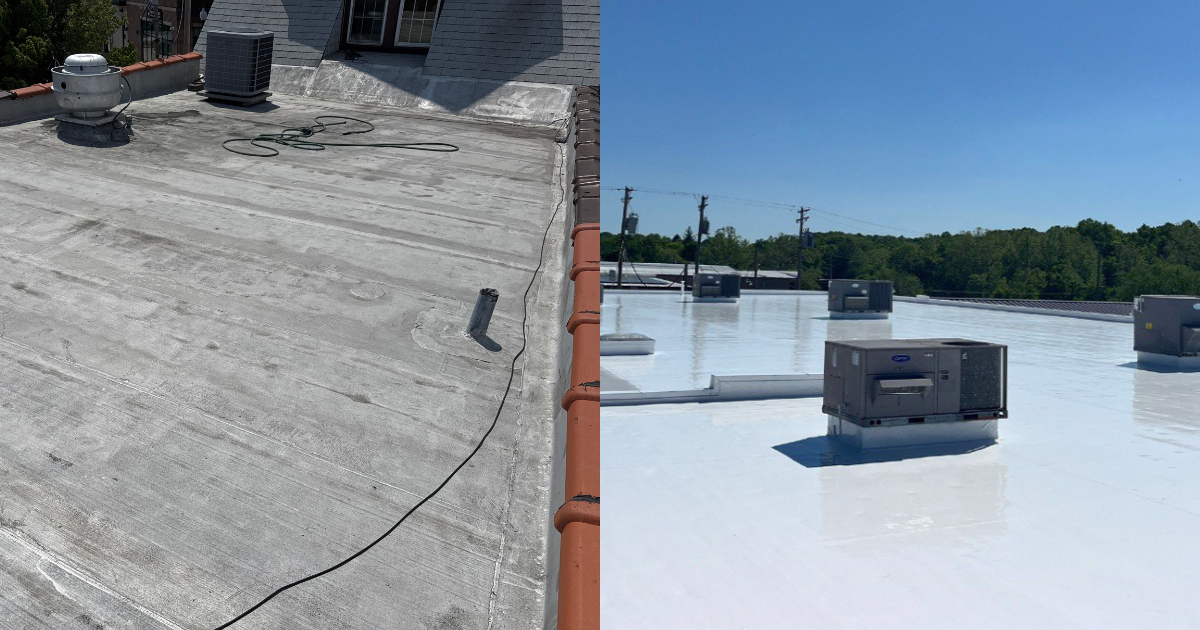
Welcome to the next generation
This is not the same elastomer your hardware store sells in a bucket. This is a reinforced urethane system engineered for the exact abuse Northwest Indiana dishes out. Heat. Cold. Freeze. Thaw. And wind that comes looking for a weak corner and does not find one.
A building owner does not need to track any of this personally. That is the point of professional standing behind the work. Someone shows up every six months, touches it up, documents the progress, and cleans it. For 20 years, that is handled. After 20 years, the topcoat gets refreshed, that hits the reset button, and the roof is good for another 20 years after that.
Compare that to the usual life of a seamed roof. Every year or two, someone walks it looking for lifted seams and worn spots. Every storm means a call to check for damage that may or may not show up right away. Every decade or so, a section starts failing and needs patched, and patches on old material rarely hold as well as the original ever did. That is a lot of maintenance for a roof that was designed with a built-in weak point on day one.
The next level of chemistry has arrived. Significantly reduced risk, because the risk used to live in the seams, and now there are no seams.
Get Your Roof Evaluated
Curious what your building's specific risk looks like? Tell us the Subject Property Address and we will walk the corners, the edges, and every rooftop penetration before we recommend anything.
The Bottom Line
Weather will keep moving at full speed. That part is not up to us. What is up to us is whether your roof has a seam waiting to come apart when the wind goes looking for one.
Build it as one piece, and the corners stop being the weak point. They become the strong point.
Had a storm roll through? Get the corners and the pipes checked before the next one.
Ask us about the seamless, reinforced, wall-to-wall system we bake right onto your roof.
Share your Subject Property Address and we will schedule the walk.
Read other blog:

We Love Conversations
 SoHelpful@PristineIndustrialRoofing.com