
Should You Restore or Replace Your Commercial Roof?
You do not always have to replace it. You do not always get to restore it. But you do have to look at it. And you haven't.
🔲 Three honest age brackets, and what each one means for your wallet.
🔲 How to know if restoration is even possible on your roof.
🔲 Why doing nothing is the most expensive option on the table.
🔲 What a professional assessment actually includes.
— The Question Every Building Owner Avoids —
Why Haven't You Looked at It?
Let us be honest with each other for a moment.
The roof is out of sight. So it is out of mind.
And if the ceiling tiles are dry, there is no urgency. Right?
Tommy on the drive home: "If nothing is leaking, what is the problem?"
Great question, Tommy. Here is the answer most adults do not want to hear.
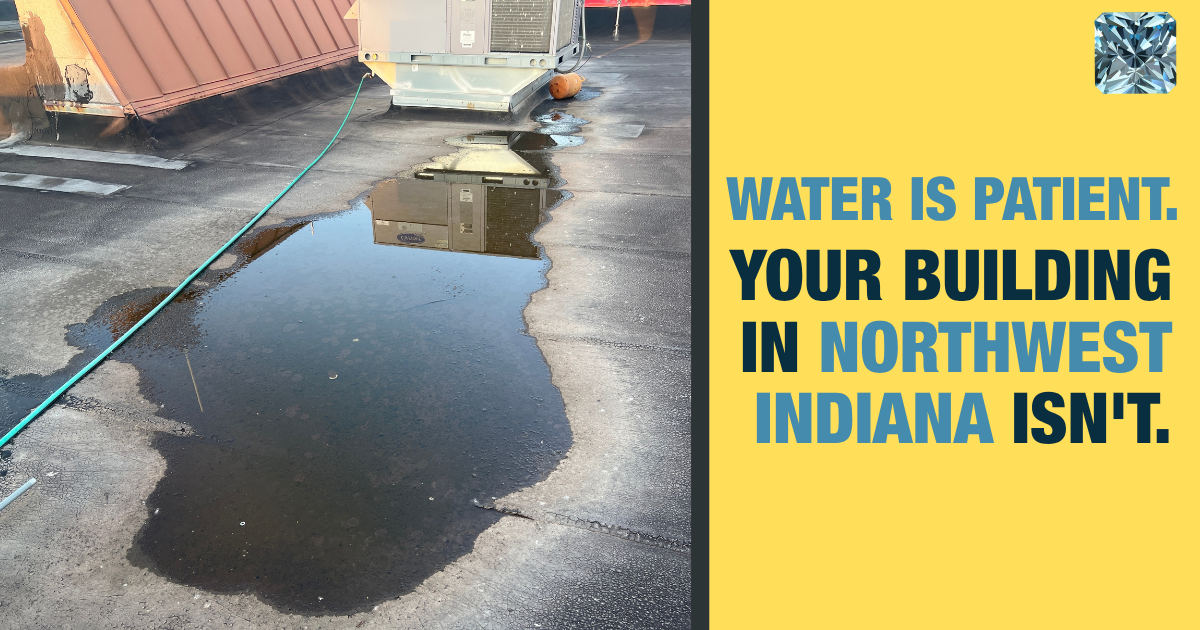
A flat roof leak almost never starts as a leak. It starts as a small problem at a seam or a flashing or around a vent pipe. The water gets into the insulation underneath. The insulation soaks it up like a sponge.
That sponge can sit there for one to three years before a single drop ever shows up on the ceiling tile in your office.
So by the time the ceiling tile turns brown, the damage upstairs is already extensive.
The leak is not the problem. The leak is the smoke alarm. The fire has been burning for a while.
Out of Sight Does Not Mean Out of Budget
Here is what 20 years of climbing roofs in Lake and Porter County has taught us.
Pristine has walked over 120 commercial roofs across Northwest Indiana. The pattern is depressingly consistent.
Roofs that have not been professionally inspected in five or more years almost always have at least one of three problems:
- Failing seams, flashing, or perimeter attachment. Easy to fix early. Expensive to ignore.
- Wet insulation in localized zones, usually around HVAC curbs, drains, and pipe vents. Invisible from below until the ceiling stains appear.
- Deteriorated coating or membrane that is rapidly approaching the point of no return, when restoration is still possible but only barely.
Every year of neglect adds to the repair cost. Water finds what you ignore.
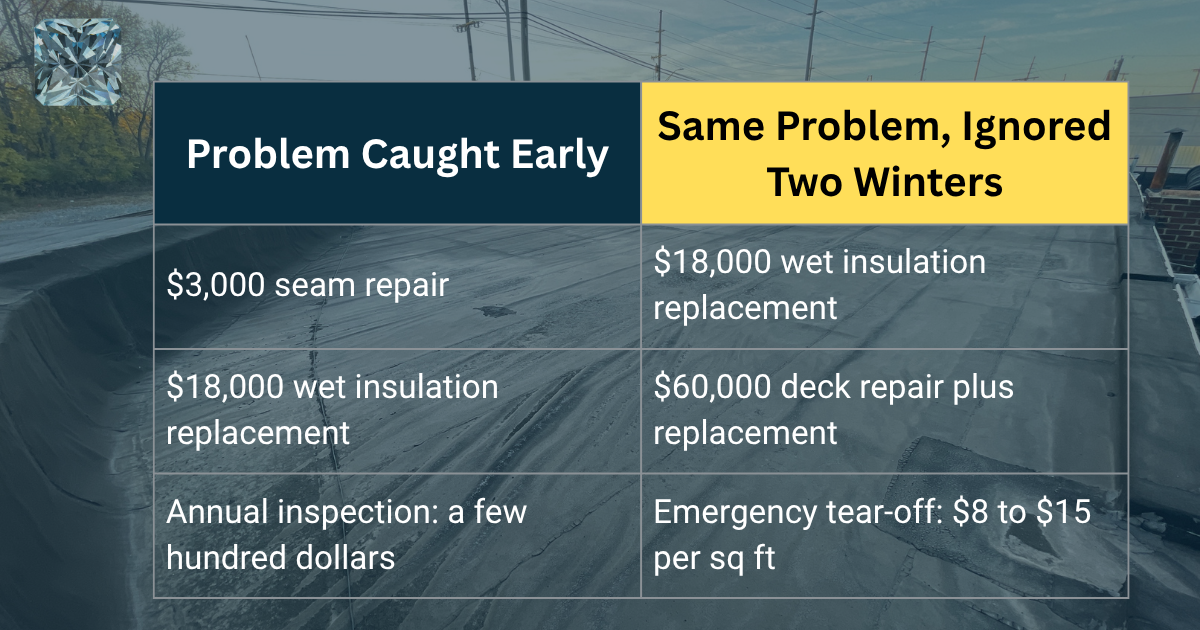
Read that table twice. The same problem, addressed today versus addressed two winters from now, is the difference between a small invoice and a six-figure capital project.
Consideration requires energy. But avoidance is expensive.
— Elementary Level —
Three Age Brackets. Three Different Conversations.
Every commercial roof on earth falls into one of three age brackets. Each one calls for a completely different answer.
Tommy on the drive home: "So I just need to know how old it is?"
Pretty much, Tommy. The age tells us almost everything we need to know about whether to restore it, replace it, or just maintain it.
Think of it like your car. A three-year-old car needs an oil change. A ten-year-old car needs an oil change AND a brake job AND maybe new tires. A twenty-year-old car needs a decision: keep pouring money into it, or replace it.
Roofs work exactly the same way. Same logic. Same brackets. Same math.


[ SCIENCE CLASS ] What a Real Moisture Survey Actually Does
Before any restoration decision is final, the existing roof must be tested for trapped moisture. There are two industry-accepted methods.
Infrared thermal imaging — performed at dusk on a clear day after the sun has heated the roof surface. Wet zones in the insulation retain heat longer than dry zones, glowing brighter on the thermal camera. A trained operator can map the entire roof in 30 to 60 minutes for a 50,000 sq ft building. Non-destructive, repeatable, and admissible in insurance claims.
Core sampling — physical 4-inch diameter plug pulled through the membrane down to the deck, allowing direct visual inspection of every layer. More definitive than infrared. Required where infrared is inconclusive. Each core hole is professionally patched as part of the survey.
Most buildings need both methods. Infrared finds the suspect zones. Core sampling confirms what's actually happening below the membrane in those zones. The combined survey usually costs less than 0.5% of a typical replacement project and saves the building owner from coating over a problem that will fail the warranty within 18 months.
How to Tell Which Bracket You're In
You do not need a contractor to make an initial guess. The five basic indicators are visible from the parking lot or the front office.
- Pull the original building permit or construction records. The roof age is usually documented. If the building changed hands, the closing documents almost always include roof history.
- Walk the perimeter of the roof from inside the building. Look at the underside of the deck wherever it's visible, at the loading dock, in mechanical rooms, in the ceiling tiles above the front office. Water stains, rust streaks, or sagging tiles are evidence of moisture issues regardless of when the last leak appeared.
- Check your HVAC service records. Roof penetrations around HVAC curbs are the most common leak source on flat roofs. If your HVAC tech has noted moisture or rust around the units, that's the roof talking.
- Climb up to the roof, carefully, with proper fall protection, and walk it slowly. If you feel soft spots underfoot, that is wet insulation. If you see standing water more than 48 hours after a rain, your drainage is failing. If you see seams that have lifted, gravel that has migrated, or coating that has cracked or chalked, the roof is communicating its bracket.
- Have Pristine walk the roof and give you a written report. We use moisture meters and infrared cameras as standard inspection equipment. No tear-off pressure. Just the bracket diagnosis and the available options. In writing. That you can file away until the budget is ready.
Why Doing Nothing Is the Most Expensive Option
Most building owners do not actively choose to neglect their roof.
They choose to defer a decision. Which, given enough time, becomes the same thing.
Here is what deferral actually costs.

The pattern is the same on every building. The cost of fixing a roof problem is a curve, not a line. Wait one year and the cost might double. Wait three years and the cost might quintuple. Wait five years and you are not fixing a roof, you are reconstructing one.
Tommy on the drive home: "So if I had a small leak today and I waited five years, it could cost fifty times more?"
Honestly Tommy, yes. And it gets worse than that.
Because the leak you can see is never the only damage. The leak is the smoke alarm, by the time it goes off, the fire has been burning. Wet insulation has been losing R-value. Deck steel has been quietly rusting. Mold has been growing inside walls and ceiling cavities.
And the worst part: insurance often won't pay for damage caused by deferred maintenance. The carrier will look at the claim, look at the documentation showing the roof was past warranty and never inspected, and deny the claim. You become the carrier.
[ SCIENCE CLASS ] Why Liquid Restoration Wins in the 10-to-20 Year Window
The economics are straightforward. A Conklin liquid system carries a non-prorated factory warranty of 20 years on most substrates. Total installed cost typically falls between $2 and $5 per square foot, depending on the existing condition and the chemistry selected.
A full tear-off and replacement runs $8 to $15 per square foot installed, and that's before considering the cost of insulation upgrades, deck repairs discovered during tear-off, business disruption during installation, and the dumpster fees for hauling the old roof to a landfill.
For a 50,000 sq ft warehouse in the 10-to-20 year bracket, the math looks like this: restoration at $3.50/sq ft = $175,000. Replacement at $11/sq ft = $550,000. The restoration adds 15 to 20 years of life. The savings: $375,000.
And here is the part that nobody on the tear-off side wants you to know: a Conklin liquid system is RECOATABLE at year 20. Apply a fresh top coat and the warranty renews. No tear-off ever, on the right substrate, for the life of the building. That is structural longevity by design — not by accident.
Stop guessing. Let us walk your roof.
Pristine Industrial Roofing offers a full commercial roof assessment: moisture mapping with infrared imaging, membrane condition documentation, drainage evaluation, and a written report with photos. No tear-off pressure. No surprise invoices. Just the bracket diagnosis and the options, in writing, that you can file away until the budget is ready.
Call or text: (219) 529-1995 • PristineIndustrialRoofing.com • Serving Lake County, Porter County, and Southwest Michigan.
What This Series Has Covered So Far
Four articles in. Let us recap before the finale.
- Article 1 — Why your building has a flat roof. The 60-foot span economics. Bar joists. Costco. Four layers stacked, each one protecting the joists below.
- Article 2 — Tar, rubber, and plastic. The three old guys. What the U.S. Department of Defense actually says about plastic TPO. Who paid for the report?
- Article 3 — Liquid roofing chemistry. Acrylic equals water leaves. Urethane equals chemicals marry. 49 years of Conklin field performance. The 600% stretch number on Affinity.
- Article 4 (this one) — The decision framework. Three age brackets. Restoration vs. replacement math. Why doing nothing is the most expensive option.
- Article 5 — The finale. Why liquid is the right answer for most commercial buildings in Lake and Porter County. The case closed.
Here is the simple version Tommy could explain to his classmates.
Most flat roofs in Northwest Indiana are sitting at year 12, 14, 16, or 18. They are tired but not finished. They have years of life left if someone gets up there and treats them right. They will not have years of life left if everyone keeps pretending they do not exist.
The decision is not restore versus replace.
The decision is look now versus look later.
Looking now opens up cheap options. Looking later closes those options one by one until the only option left is the most expensive one on the table.
Next: Article 5 — Liquid Is Lovely.
SOURCES CITED
U.S. Department of Defense. UFC 3-110-03, Roofing. Section 6 — Re-roofing Requirements, including Section 6-3 on Mesh Reinforced Elastomeric Roof Coatings (MREC) for restoration applications. 1 May 2012, with Change 5 dated 12 June 2020.
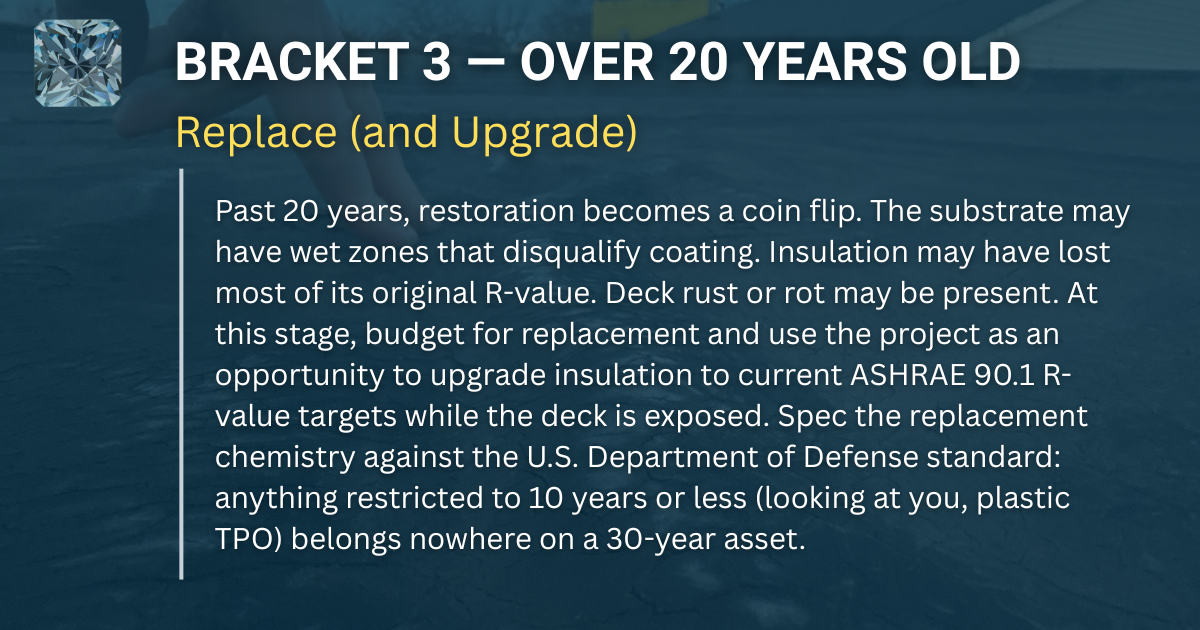
ASHRAE 90.1. Energy Standard for Buildings Except Low-Rise Residential Buildings. Current edition. R-value requirements for roof assemblies by climate zone — referenced for replacement-stage insulation upgrades.
National Roofing Contractors Association (NRCA). NRCA Roofing Manual, current editions. Moisture survey methodology, core sampling protocols, and life cycle cost analysis frameworks.
Cool Roof Rating Council. Third-party verified solar reflectance and SRI ratings for Conklin Snow Leopard, Rapid Roof III, Affinity, and FLEXION 2.0 — used in restoration vs. replacement energy modeling.
Pristine Industrial Roofing internal data. Field documentation from 120+ commercial roof evaluations across Lake County, Porter County, and Southwest Michigan, 2020 to present.
PRISTINE INDUSTRIAL ROOFING
Lake & Porter Counties, Northwest Indiana • Southwest Michigan
(219) 529-1995 • BigRoofLibrary.com • ModernRoofChemistry.com
A Gospel Business — Profits Fund Worldwide Missions and Community Outreach
Read other blog:


We Love Conversations
 SoHelpful@PristineIndustrialRoofing.com