
The Roof That Was Cooking the Building
One NIPSCO bill. One question. One roof.

🔲 Your roof may be 170°F right now. Dark commercial roofs hit 160 to 175°F on a summer afternoon. That heat doesn't stay outside.
🔲 One hot afternoon inflates the whole month's bill. NIPSCO charges peak demand. The hottest hour of July can drive your entire billing cycle.
🔲 White doesn't mean white for long. Commodity TPO dims out by year three to five, especially when not cleaned regularly. Conklin's PVC chemistry holds reflectance.
🔲 No tear-off. No downtime. No deck exposure. Conklin is liquid-applied over your existing roof. The building keeps running while the system goes on.
A Northwest Indiana Commercial Roofing Story
The July heat hit Hammond early this year.
By 9:30 in the morning, the warehouse office already felt wrong. The air conditioner was running, but the building never seemed to cool down. Employees complained first. Then the thermostat wars started. Then came the electric bill.
Bill sat at the conference table staring at the NIPSCO statement like it had personally insulted him.
“How does a building this big suddenly cost this much to cool?”
Meg already knew the answer.
“It’s the roof.”
Not the HVAC unit. Not the thermostat settings. Not the employees leaving doors open.
The roof.
Because while the outdoor temperature peaked at 90 degrees that afternoon, the surface of Bill’s dark commercial roof was pushing nearly 170 degrees Fahrenheit. Hot enough to fry skin. Hot enough to turn the entire building into a slow cooker.
And that heat wasn’t staying outside.
It was driving through the roofing system, through the decking, into the occupied space below, forcing the HVAC system to fight a battle it could never fully win.
That’s when Meg called for a roofing evaluation.
And that’s when they learned the difference between a roof that merely covers a building… and a roof designed to control heat.
What White Roofing Actually Changes
Most building owners think roofing is about leaks. The smart ones eventually realize roofing is really about heat.
Every commercial roof absorbs solar radiation all day long. Dark roofing systems absorb most of it. White roofing systems reflect it away before it ever enters the building. The difference is massive.
A traditional dark roof may reflect only 5 to 15% of incoming solar energy. The rest becomes heat.
A properly installed Conklin white roofing system reflects as much as 80 to 88%.
That means instead of absorbing nearly all the sun’s energy, the roof rejects most of it back into the atmosphere. And in Northwest Indiana summers, that changes everything.
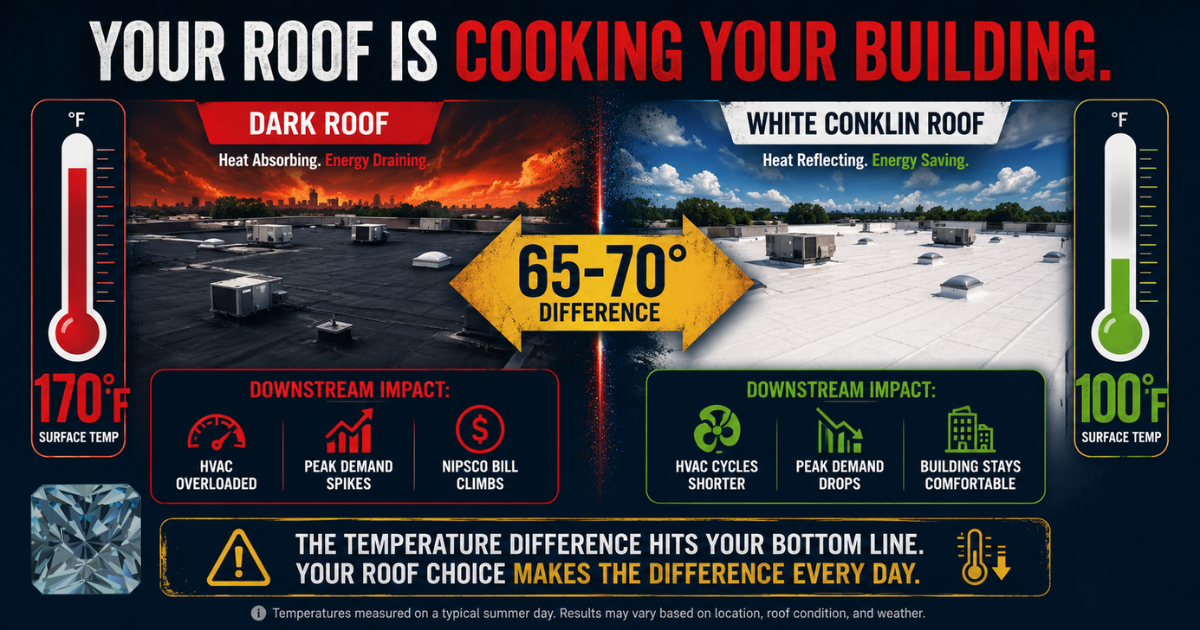
On buildings across the area, dark roofs regularly reach 160 to 175°F during peak summer afternoons.
A high-performance white Conklin coating typically stays between 95 to 105°F.
That is not a small improvement.
That is a 65 to 70 degree surface temperature swing sitting directly above your people, inventory, equipment, and operating space.
Why the HVAC Never Stands a Chance
Bill thought his air conditioning system was failing.
It wasn’t.
It was overwhelmed.
Most commercial buildings in were never designed for modern cooling demands. Metal decking, limited insulation, open warehouse ceilings, all of it allows roof heat to transfer downward quickly.
So while the thermostat says 74 degrees, the HVAC system is fighting a roof surface hotter than boiling water.
That heat radiates downward hour after hour. The cooling system runs longer cycles. Peak electrical demand spikes.
And NIPSCO records those spikes. That’s the part many owners miss.
Commercial utility bills aren’t based only on energy used. They’re also based on peak demand, the highest electrical draw your building hits during the billing cycle.
One brutal July afternoon can affect the entire month’s bill.
Which means the real enemy isn’t simply heat.
It’s accumulated roof heat.
Reduce the roof temperature by 60 or 70 degrees, and suddenly the HVAC system reaches setpoint faster, cycles shorter, and draws less peak power.
The building starts behaving normally again.
The Problem With Cheap & Dirty Roofing
By this point, Bill figured the solution was easy.
“Fine,” he said. “We’ll just install a white roof.”
Not exactly.
Because not all white roofing performs the same.
Commodity white TPO roofing starts-off reflective. The problem comes later.
By years three to five, many standard TPO systems begin chalking, collecting contamination, and losing reflectivity. They still look white, but they stop performing white.
The top several mills are called the scrim. The scrim gets eaten away by acid in the rain since we have the metal refineries and oil refineries locally. And once reflectivity drops, heat absorption rises again.
That’s where Conklin systems separate themselves.
Conklin’s coating chemistry was engineered to resist chalking and contamination buildup over the long term. The system remains thermally functional year after year, not just visually white on installation day.
There’s another advantage too.
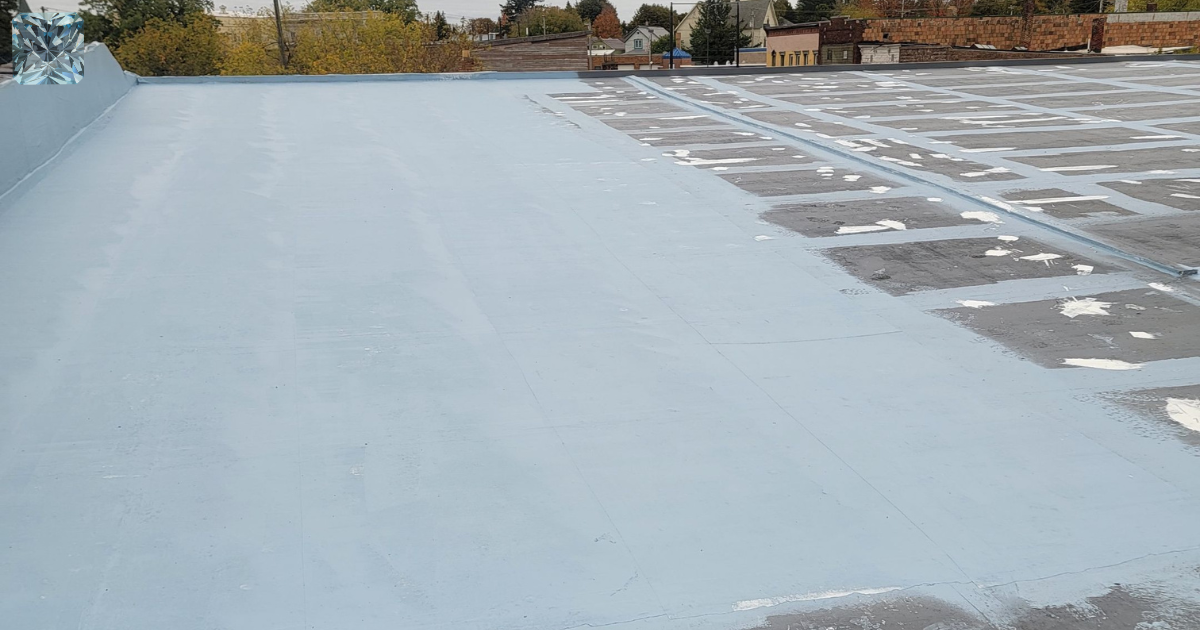
Conklin systems are liquid-applied.
Instead of relying on seams and rolls like traditional membrane systems, the coating cures directly over the existing substrate, sealing irregularities, seams, and vulnerable transition points in one continuous surface.
No tear-off.
No landfill cost.
No exposing the deck during installation.
For operational facilities, that matters as much as the energy savings.
The Real Cost of Waiting
Meg understood the numbers before Bill did.
The issue wasn’t just this summer’s utility bill.
It was the compounding cost of delay.
Every overheated summer forces aging HVAC equipment to operate at maximum load for longer periods. Compressors wear faster. Maintenance increases. Equipment lifespan shortens.
The building slowly becomes more expensive to operate every year.
And meanwhile, the roof continues baking the structure from above.
The financial damage compounds quietly.
That’s why the smartest building owners don’t wait for catastrophic failure.
They act when the warning signs appear,
- HVAC systems struggling during afternoons
- Rising NIPSCO demand charges
- Uneven building temperatures
- Older dark roofing systems
- Constant summer discomfort complaints
By the time the roof leaks, the energy losses have usually been happening for years.
✉️ If your building runs hot every summer and your NIPSCO bills keep climbing, the roof is usually where the story starts.
Subject Property Address: ___________________________
Drop the address. We provide FREE commercial roof evaluations for properties throughout Lake and Porter Counties. No pitch. No obligation.
[ Email address ] → [ Send Me the Real Stuff ]
Northwest Indiana Is Brutal on Commercial Roofs
Lake and Porter Counties create a perfect environment for heat buildup. Industrial density traps heat. Lake-effect humidity accelerates roof contamination.
Long summer cooling seasons keep HVAC systems under constant stress. And many older industrial properties were built long before energy efficiency became a priority. That’s why white roofing performs especially well here. The hotter the building runs, the larger the improvement becomes.
Ironically, many owners still worry about winter performance. They assume a reflective roof will somehow increase heating costs.
In reality, commercial buildings rely primarily on mechanical heating systems, not solar heat gain through the roof.
Winter energy loss comes through poor insulation, seam failures, and air leakage.
Not roof color.
So the white roof improves summer efficiency without meaningfully hurting winter performance.
Which means the biggest utility problem gets solved without creating a new one.
White Roofing FAQs
Q: How much can a white commercial roof reduce energy costs in Northwest Indiana?
A: 30% is the national average reduction in utility bill by flipping a dark roof to bright. Actual savings vary by building, but a high-reflectance coating on a dark commercial roof can reduce cooling load meaningfully, particularly peak demand charges during Summer afternoons. Buildings with minimal insulation and older dark surfaces see the largest impact.
Q: Does NIPSCO offer rebates for commercial roofing energy upgrades?
A: Better yet, just pay them less. NIPSCO has offered rebate programs for commercial energy efficiency improvements. Program availability and qualifying criteria change, so confirm current details directly with NIPSCO or an energy consultant familiar with the service territory before planning around a specific rebate amount.
Q: What is the difference between a Conklin white coating and a white tPo membrane?
A: tPo is a PLASTIC membrane applied in rolls. A Conklin system is liquid-applied urethane or acrylic that cures in place, filling seams and surface irregularities as it sets. Conklin's formulations are chalk-resistant and hold reflectance over time. Commodity tPo typically loses meaningful reflectance by year three to five as the surface chalks and accumulates contamination.
Q: Can a Conklin white coating be applied over my existing roof?
A: In most cases, yes. Conklin liquid-applied systems are designed to go over existing substrates without tear-off, which eliminates landfill costs and avoids exposing the deck during application. A condition assessment determines suitability. If the insulation is not saggy, then liquid makes sense. If there’s structural issues, then we definitely need to consider replacing the insulation.
Q: Does a white roof hurt Winter performance in cold climates like Northwest Indiana?
A: No. Commercial buildings in the region are heated through HVAC systems, not solar gain through the roof. Winter heat loss runs through insulation gaps and seam failures, not from reduced roof surface absorption. White roofing does not meaningfully affect Winter heating loads.
Q: What does solar reflectance actually mean for a commercial roof?
A: Solar reflectance is the percentage of incoming solar energy that bounces off the surface rather than being absorbed. A dark roof reflects 5 to 15 percent. A high-performance Conklin white system reflects 80 to 88 percent, leaving significantly less solar load to enter the building.
Q: Is a white roof a good fit for industrial and warehouse buildings in Hammond or Gary?
A: Yes, and often the best fit. Industrial and warehouse stock in Lake County typically has metal decking, limited plenum space, and older insulation. Those conditions amplify the heat gain problem and make the surface temperature reduction from a white Conklin system most visible in energy spend.
Q: What is the payback period on a Conklin white coating system?
A: For some buildings less than five years. Payback depends on the building's current energy spend, roof square footage, existing insulation, and HVAC efficiency. The case is strongest for buildings running older dark surfaces with aging equipment already working near capacity. A site evaluation gives you a real number rather than a placeholder.
One Roof Can Change the Entire Building
By the end of the evaluation, Bill finally understood the problem. The roof wasn’t just sitting there. It was actively driving operational cost. Every summer afternoon. Every billing cycle. Every year.
And once you understand that, the roof stops being an expense.

It becomes infrastructure.
A properly designed white Conklin roofing system doesn’t just waterproof a building. It lowers thermal load. Reduces peak electrical demand. Extends HVAC lifespan. Improves interior comfort. And helps commercial properties operate more efficiently in the harsh realities of Northwest Indiana summers.
All from the top of the building.
✉️ Bill's building was cooking from the top down. The fix wasn't the HVAC. It wasn't the thermostat. It was the roof.
If your energy bills spike every July, your cooling system never catches up, or your building just runs warm, we want to see the roof.
Subject Property Address: ___________________________
Drop the address. No pressure. No commitment. Just a clear picture of what's happening above your roof.
[ Email address ] → [ Send Me the Real Stuff ]
Pristine Industrial Roofing
Lake & Porter Counties │ Commercial Flat Roofing │ Conklin Certified
(219) 529-1995 │ ModernRoofChemistry.com
A Gospel Business │ Community Outreach & Worldwide Missions
We love you enough to tell you the truth.
Read other blog:



We Love Conversations
 SoHelpful@PristineIndustrialRoofing.com