
Liquid Is Lovely
No seams. No glue. No gaps. One continuous skin from drain to parapet. This is where the whole series has been pointing.
🔲 Why a seamless roof is fundamentally different from a sheet roof.
🔲 What "recoatable forever" actually means for your building's lifecycle.
🔲 How liquid roofing wins the cool roof, the cost curve, and the calendar.
🔲 Why Pristine bets the whole company on Conklin liquid chemistry.
— Elementary Level —
The Big Beautiful Bathtub
Imagine your warehouse roof is the inside of a bathtub.
One continuous surface. White. Smooth. Curving up the walls at every edge.
Water lands. Water flows. Water leaves through the drain. The bathtub does not leak. Because the bathtub is one piece.
Tommy on the drive home: "So the roof should be like a bathtub?"
Exactly right, Tommy. That is the goal of every flat roof. To behave like the inside of a bathtub.
Now think about every other flat roof you have looked at in this series.
Tar and gravel: layers stacked, seams everywhere underneath the rocks.
Rubber: big sheets glued together with seam tape every 10 feet.
Plastic: rolls heat-welded together every 8 feet.
None of those are bathtubs. They are quilts. Stitched together, hoping the stitches hold.
A liquid roof is the bathtub.
One sprayer. One pour. Edge to edge. No seams. No stitches. No quilts.
That is the whole argument in one sentence.
Tommy on the drive home: "So why doesn't everybody have a bathtub roof?"
Honest answer, Tommy. Because for 80 years, nobody knew how to make one.
Hot tar mopped on felt was the only option for the first half of the 20th century. Then rubber sheets came along in the 1970s. Then plastic sheets came along in the 1990s. Each one was a step forward from the one before. But none of them were bathtubs. All of them were quilts.
In 1977, Conklin invented a liquid that could be sprayed onto a roof and would cure into one continuous flexible skin. That was the bathtub moment. Forty-nine years ago.
The chemistry has been refined every decade since. The original Rapid Roof was good. Rapid Roof III is better. Affinity urethane is better still. Snow Leopard added bright white reflectivity to the metal market.
Most of the flat-roof world is still selling quilts because that is what most contractors know how to install.
Pristine is in the bathtub business.
Six Reasons Liquid Is Lovely
Let us count them on one hand. Plus one more for the thumb.
1. Liquid Is Seamless.
A 50,000 square foot rolled roof has roughly 6,000 linear feet of seams. That is more than a mile of stitching across your warehouse.
A 50,000 square foot Conklin liquid roof has zero linear feet of seams. One continuous monolithic membrane. Drain to parapet. No exceptions.
Seams are where roofs leak. Eliminate the seams and you eliminate the leaks.
Tommy on the drive home: "So a mile of stitching versus zero stitching?"
Right. A mile of potential weak points versus none. And that one mile of stitching has to survive 50 years of expanding in the summer heat and contracting in the winter cold, while being walked on, while being baked by UV rays, while being soaked by rain. The math is brutal. Every seam is a future leak waiting for its turn.
2. Liquid Is Recoatable Forever.
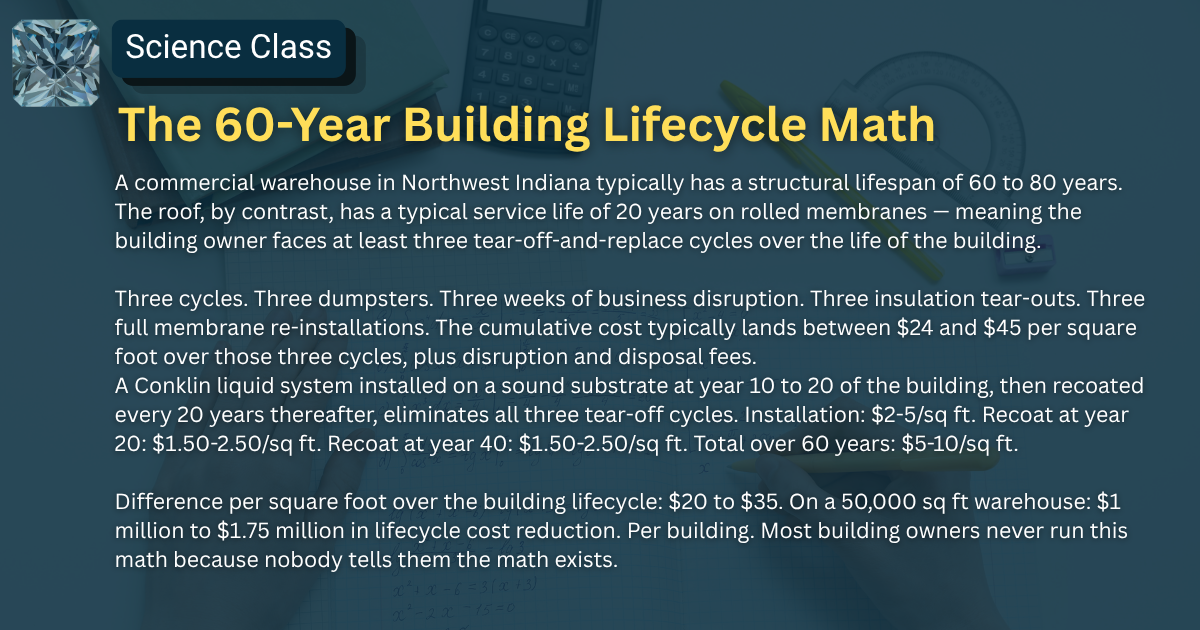
Every rolled roof has an end date. At year 15, 20, or 25, the membrane comes off. Tear-off. Dumpster. Disposal fee. New membrane. New seams. New problems.
A Conklin liquid roof does not come off. At year 20, when the top coat starts to weather, a fresh top coat goes down on top of the existing system. The warranty renews. The chemistry continues. The building gets another 20 years.
Repeat as many times as the building stands. The roof becomes a renewable system, not a disposable one.
3. Liquid Is Cool.
Conklin Snow Leopard reflects 85 percent of the sun's heat before it ever touches your insulation. The Cool Roof Rating Council has verified that number independently. So has Oak Ridge National Laboratory in their field studies.
Translation: your NIPSCO bill drops about 25 percent in the summer months on a converted black-roof building. On a 50,000 square foot warehouse, that is real money, typically $4,000 to $8,000 per year in cooling savings alone.
Over a 20-year warranty period, the energy savings can pay for the entire roof installation by themselves.
4. Liquid Is Light.
A liquid roof system adds about 0.3 pounds per square foot to your existing structure. A tear-off and replacement with a new rolled membrane adds 1 to 2 pounds per square foot if you have to also replace insulation. A built-up tar roof can weigh 25 pounds per square foot.
Lighter is friendlier to your existing bar joists. Lighter means more capacity left for solar panels, additional HVAC units, or whatever rooftop assets the next ten years bring to your business.

5. Liquid Is Walkable.
Conklin coatings are factory-rated for foot traffic. HVAC technicians can service the units without damaging the membrane. The roof can be cleaned, inspected, and maintained without ladders, lifts, or special equipment.
Compare that to ballasted rubber roofs (river rock makes them dangerous to walk on) or fragile TPO plastic systems that puncture under tool drops. Walkability is not a luxury, it is the difference between a maintainable asset and an avoidable one.
6. Liquid Is Patchable Without Drama.
If a fastener drops on your liquid roof and creates a small puncture, the repair takes 30 minutes. Clean the area. Apply Spunflex mesh. Coat over it. Done. The repair becomes part of the original system because the chemistry is identical.
Compare that to a rolled roof repair, which requires matching exact membrane thickness, color, and chemistry, and which always shows up as a visible patch with new seams around its perimeter. New seams. Future leak points.
(And the Thumb) 7. Liquid Is Quiet.
No tear-off crew. No dumpsters in the parking lot for two weeks. No business disruption while the building sits exposed to weather. The crew comes in, applies the chemistry, and leaves.
Your tenants notice nothing. Your customers notice nothing. Your operations continue uninterrupted. The roof gets renewed quietly, on weekends or off-hours, with no downtime.
If Not Liquid, Then Vinyl
There are buildings where liquid is not the right answer.
A roof with extensive wet insulation cannot be coated over, the insulation has to come out first. A roof past 25 years of service life with widespread deck issues is usually past the restoration window. A building with chemical exposure beyond what Conklin chemistry is rated for needs a different solution.
In those cases, the right answer is rolled vinyl, specifically FLEXION 2.0.
PVC vinyl is the only thermoplastic the U.S. Department of Defense actually trusts for long-term applications. UFC 3-110-03 says PVC has the longest time in service of any weldable thermoplastic. The DoD spec also recommends PVC specifically for HVAC platforms on metal roofs, where chemical resistance and watertight detailing matter most.
Tommy on the drive home: "So if the building can have liquid, use liquid. And if it can't, use vinyl?"
Exactly right, Tommy. Liquid first. Vinyl second. Plastic last.
That is the entire Pristine philosophy in three sentences.
📥 DOWNLOAD THE SPEC SHEET: FLEXION 2.0 — When Liquid Is Not the Answer
PVC D4434 Type III. Kevlar-reinforced edge. DuPont Elvaloy scrim. 60-mil thickness. 25-year factory warranty. The DoD's preferred thermoplastic. Acid, grease, and chemical resistant.
→ Click here to download (PDF)
What Liquid Lovely Costs
The pricing has been scattered across the previous four articles. Here it is in one place.
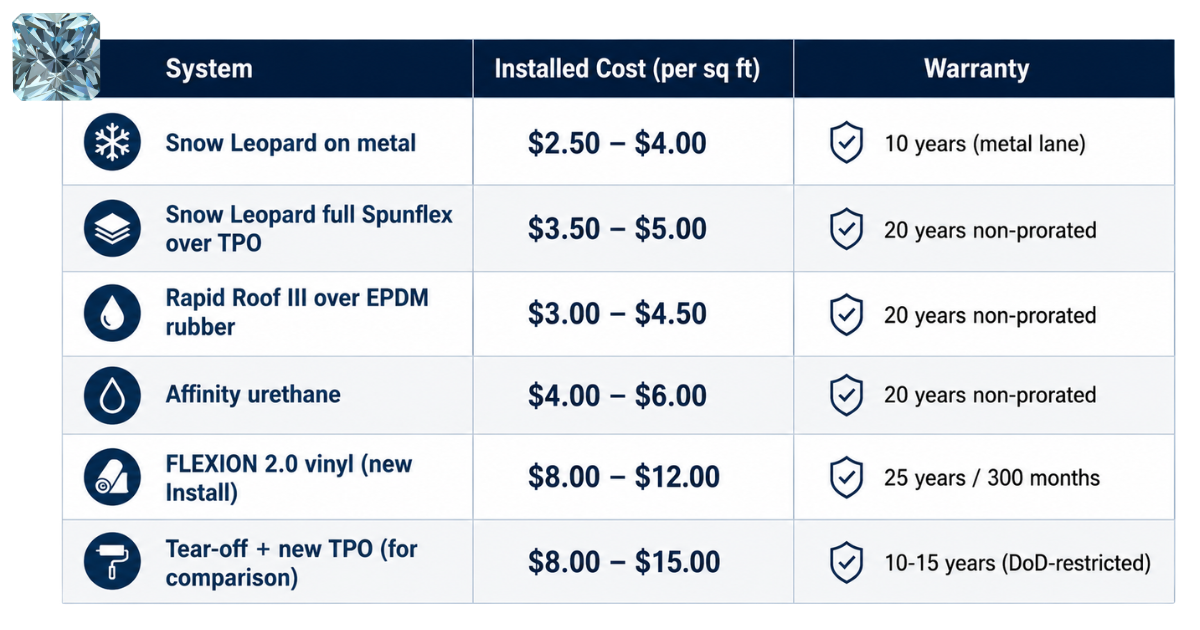
Every Pristine proposal arrives with a Platinum Pattern Excel workbook that breaks the cost down line by line. Materials. Labor. Tax. Freight. Margin. Every number adjustable. Every assumption documented.
No surprises. No hidden fees. No "we found something else once we got up there."
Why Pristine Bet the Whole Company on Liquid
Pristine Industrial Roofing is a Conklin-certified contractor. That is not a small thing.
To stay Conklin certified, at least 66 percent of our annual material orders have to be Conklin liquid systems. Two out of every three jobs has to be liquid.
That is not a marketing claim. That is a contractual obligation built into our manufacturer relationship.
Most contractors hedge across many manufacturers and many chemistries. The hedge protects the contractor. The hedge does not protect the building owner.
Pristine made the opposite bet. We picked the chemistry that has the longest field track record, the most independent third-party validation, the strongest warranty structure, and the lowest lifecycle cost, and we built the whole company on it.
There is one more reason that does not fit on a spec sheet.
Pristine Industrial Roofing is a Gospel business. The profits from every job fund worldwide missions and community outreach. The harder we work on commercial excellence, the more lives get touched by the work that excellence funds.
That changes how we pick chemistry. We cannot afford to sell the building owner a 10-year roof on a 30-year building. We cannot afford to play short games. Every callback, every warranty claim, every avoidable failure is money that does not get to do the work it was supposed to do.
So we bet the whole company on the chemistry with the longest track record, the most independent validation, and the lowest lifecycle cost.
Liquid first. Vinyl second. Plastic last. That is the order. Every job. Every quote. Every building owner conversation.
Our role is to be the explainers.
Five articles. Tens of thousands of words. Federal sources. ASTM standards. Cool Roof Rating Council data. Independent contractor field reports.
Everything sourced. Everything explainable. To Tommy, to Sally, to the seven-year-old in the back seat, and to the multi-millionaire owner of the 100,000 sq ft warehouse in Merrillville.
The Series in One Sentence
Tommy can explain the whole series in one sentence.

Pristine will walk the roof. Pristine will write the report. Pristine will explain the brackets, the chemistry, and the math.
No tear-off pressure. No surprise invoices. No marketing claims that contradict the federal specification.
Just the truth, sourced, and the options.
Five articles in. Time to look at the roof.
Pristine Industrial Roofing offers a full commercial roof assessment: moisture mapping with infrared imaging, membrane condition documentation, drainage evaluation, and a written report with photos and bracket diagnosis. No tear-off pressure. No surprise invoices. Just the diagnosis, the options, and the math — in writing — that you can file away until the budget is ready.
Call or text: (219) 529-1995 • PristineIndustrialRoofing.com • Serving Lake County, Porter County, and Southwest Michigan.
The Flat Roof Series is complete. Five articles. One foundation. BigRoofLibrary.com is your library, bookmark it and return when the next roof question arrives.
Sources Cited
U.S. Department of Defense. UFC 3-110-03, Roofing. 1 May 2012, with Change 5 dated 12 June 2020. Sections on PVC vs. TPO, mesh-reinforced elastomeric coatings, and HVAC platform specification.
ASTM International. D6083 (acrylic coatings), D4434 (PVC sheet roofing), D-412 (elastomer tension testing), D4798 (accelerated weathering).
Cool Roof Rating Council. Third-party verified solar reflectance, thermal emittance, and SRI ratings for Conklin Snow Leopard, Rapid Roof III, Affinity, and FLEXION 2.0.
Oak Ridge National Laboratory. Cool roof field testing and Whole Building Energy Savings Calculator. ORNL Energy Division research on solar reflectance and cooling load reduction.
Conklin Company. Product specification sheets, historical record from 1977 to present, and master contractor field reports. Conklin Company, Kansas City, Missouri.
Pristine Industrial Roofing internal data. Field documentation from 120+ commercial roof evaluations across Lake County, Porter County, and Southwest Michigan, 2020 to present.
PRISTINE INDUSTRIAL ROOFING
Lake & Porter Counties, Northwest Indiana • Southwest Michigan
(219) 529-1995 • BigRoofLibrary.com • ModernRoofChemistry.com
A Gospel Business — Profits Fund Worldwide Missions and Community Outreach
Read other blog:


We Love Conversations
 SoHelpful@PristineIndustrialRoofing.com