
Your Roof Didn't Fail. Its Seams Did.
Why flat roofs in Northwest Indiana leak in the same places every time, and the one fix that actually stops it.

🔲 Seams don't age gracefully. They age fast.
🔲 Patches don't fix seams. They add to them.
🔲 NWI's freeze-thaw cycle is not average. Your roof knows it.
🔲 One seamless surface. No edges. No excuses.
🔲 Conklin's renewable warranty doesn't expire. It resets.
Skip This. Unless You've Patched the Same Leak Twice.
Perhaps your flat roof is failing in ways your maintenance team hasn't named yet.
Every sheet-based membrane installed on your building has seams. Dozens of them. Each one is a bond between two pieces of material held together by adhesive that has a timer on it.
Not your problem? Good. Close it.
Your problem? Read every word.
What Seam Failure Actually Looks Like
It starts small. It escalates faster than you think.
You notice a water stain on a ceiling tile in the back hallway.
Maintenance throws caulk at the lap. The stain dries. Two months later it's back, six inches wider.
That's not a mystery. That's a seam failing.
The caulk didn't fix the seam. It redirected the water one step further down the lap until it found a new exit. Meanwhile, water is sitting inside your insulation layer. It's soaking into the deck. The R-value you paid for is dropping. Your NIPSCO bill is climbing.
Nobody connected those two facts because they look like separate problems.
They're not separate problems. They're the same seam.
In Merrillville and across Northwest Indiana, we've walked buildings where owners had been patching the same general area for eight, ten, sometimes twelve years. Every repair looked different. Different roofer, different product, different section of membrane they blamed. Same root cause every single time.
The seam was never fixed. It was only moved.
Your roof has seams. Let's find out how many are failing.
Call or text: (219) 529-1995 • PristineIndustrialRoofing.com • Serving Lake County, Porter County, and Southwest Michigan.
Patching Doesn't Fix the Seam. It adds to it.
You're not solving the problem. You're relocating it.
A seam patch does one thing, it covers the spot where water entered last time.
It does nothing to the lap on either side of that spot. It does nothing to the adhesive bond that's been slowly releasing for three seasons. And it adds a new edge, the edge of the patch itself, which is now its own seam.
So after the patch, you have the same number of seams you started with. Plus one.
This is why some buildings end up with what we call a patchwork roof, a surface that looks like a quilt of repair materials layered over years of failed repairs. Each one was technically correct. None of them solved anything.
We're not being harsh about the contractors who did that work. Most of them were doing exactly what the building owner asked for: fix this leak, keep costs down, don't tear anything off.
They delivered on the brief. The brief was wrong.
The brief should have been: stop the seams from failing.
The Fix is to Get Rid of the Seams Entirely.
One seamless surface. Edge to edge. Wall to wall. No exceptions.
Conklin's liquid-applied coating systems don't patch over seams. They eliminate them.
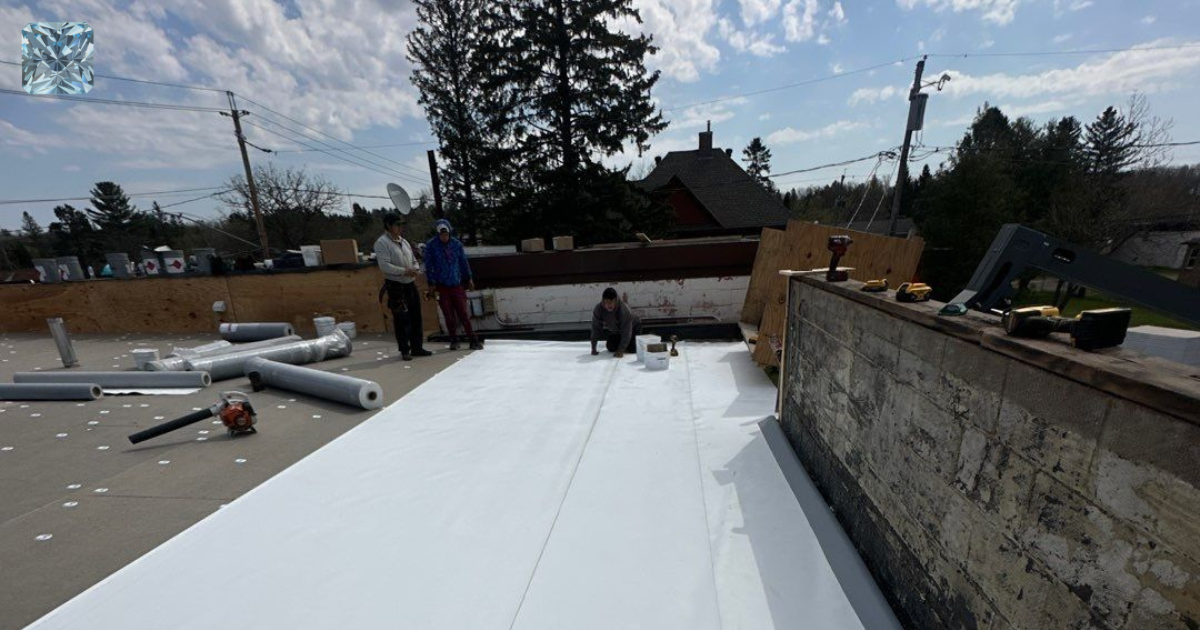
Here's how it works. We clean the existing surface. We embed a layer of reinforcing fabric into the wet coating, that's the part that gives it tensile strength, so the skin moves with your building through every freeze and thaw cycle without tearing. Then we apply the topcoat over the full surface, edge to edge, wall to wall, up the parapets, around every penetration.
When it cures, there are no seams. Not fewer seams. None.
The whole roof becomes one continuous membrane, the same way a bathtub is one continuous surface.
Does your bathtub have seams? No. There's a reason it holds water for fifty years.
That's the physics we're applying to your roof.
The Conklin system is factory-certified and comes with a renewable warranty. It doesn't expire and get replaced by a new roof. It gets renewed. We come back, inspect, apply a maintenance coat if the surface calls for it, and the warranty clock resets.
One roof. Indefinitely. No tear-off. No five-figure replacement cycle every fifteen years.
For building owners across Northwest Indiana who are tired of the patch-and-pray cycle, this is the exit ramp.
Northwest Indiana Weather is Not Average
Our temperature swings are not forgiving to glued seams.
The chemistry behind seam failure accelerates with thermal cycling. Every time your roof heats up and cools down, the membrane expands and contracts. The adhesive bonding the laps flexes, and every flex cycle wears it down a little more.
In Northwest Indiana, we don't just get cold winters and hot summers. We get radical swings within a single week. A January thaw that takes a roof from zero degrees to forty-five in two days, then back to single digits three days later. A July heat dome that pushes a dark membrane surface past one hundred and sixty degrees before a cold front drops it thirty degrees overnight.
Each one of those swings is a lap separation event at the microscopic level.
Stack enough of them over enough years and the laps don't just lift, they open.
The liquid systems are designed for this. Urethane and acrylic coatings flex. They don't fight the movement. When the fabric reinforcement is embedded in the coating layer, the system moves as one piece instead of as a stack of bonded panels fighting each other.
That's not a sales line. That's material science.

What a Building Owner in Merrillville Already Figured Out
The same roof, two different decisions, two very different outcomes.
A few years back we looked at a warehouse in Merrillville. The owner had been managing leaks for close to a decade. Three different contractors. The building had sections of expired rubber EPDM over modified bitumen over torch-down, layers of solution stacked on top of layers of problem.
He was ready to price a full tear-off. His number was somewhere north of two hundred thousand dollars.
We pulled back enough surface to assess what was underneath. The deck was solid. The insulation had some saturation in two corners but the majority was recoverable. The actual problem was what it always is: laps. Everywhere.
We laid the Conklin system over the recoverable sections, addressed the two saturated corners properly, and gave him a seamless surface at roughly forty percent of the tear-off quote.
His ceiling stains didn't come back. His NIPSCO bills dropped. His warranty reset.
He didn't need a new roof. He needed his seams to disappear.
When You Actually Do Need a Full Tear-Off
Honesty first. Not every roof is a coating candidate.
We're going to tell you the truth here because it's the only way this conversation is worth having.
If more than twenty-five percent of your insulation is saturated, we're going to have a different conversation. Coating over waterlogged insulation seals moisture into the deck and accelerates damage from underneath. That's a worse outcome than doing nothing.
If the deck is compromised, rotted wood, corroded steel, deteriorated concrete, that gets addressed before anything goes on top of it.
And if the existing membrane has so many layers that another coating system would create a structural load or adhesion problem, we'll say so.
In those cases, a tear-off is the right answer and we'll say it plainly.
What we won't do is sell you a coating as a cosmetic fix over a structural problem. That's not a business we want.
But in the majority of buildings we inspect across Northwest Indiana, intact decks, recoverable insulation, membranes failing at their seams rather than at their core, the coating system is the right call. The cost savings are real.
Your building has a maintenance team. It has a NIPSCO bill. It has an insurance carrier paying close attention to your roof's condition.
It has seams. If your roofer's answer to recurring leaks is "we'll patch it when it gets bad," your roofer is moving the problem down the lap and calling it a repair.
The timer is running. The seams are running. Somewhere between those two clocks, the right question is: who finds out first, you or the water?
Everything Your Roofer Should Have Told You Before the Seams Failed
1. Why does my flat roof keep leaking in the same area even after repairs?
Because the seam wasn't fixed, only covered. Patches seal the last entry point but leave the lap on either side untouched. Water finds the next opening in the same lap system. The only way to stop recurring leaks is to eliminate the seam itself.
2. What's the difference between a liquid coating and a regular patch?
A patch covers one breach and creates two new edges. A liquid coating cures into one continuous seamless membrane, no edges, no laps, no adhesive bonds to fail. They're not the same category of product.
3. Can a liquid coating go over my existing membrane?
In most cases, yes, with proper preparation and a moisture inspection first. If the membrane is adhered, clean, and the insulation beneath is not saturated, a Conklin coating can go directly over it. We assess adhesion and moisture before recommending any system.
4. How long does a Conklin liquid coating last?
The base system carries a ten-year renewable warranty. Renewable means it doesn't expire and trigger a replacement cycle, it gets inspected and renewed. With proper maintenance, the same system protects a building indefinitely without a tear-off.
5. Does the liquid coating work in NWI's freeze-thaw climate?
It's designed for exactly that climate. Urethane and acrylic formulas flex through thermal cycling rather than fighting it. The embedded fabric reinforcement prevents cracking under movement. The chemistry is built for buildings that see real temperature swings.
6. How do I know if my insulation is too saturated for a coating system?
We use core sampling and infrared scanning to map moisture. If saturation is below the threshold, we document it and proceed. If it's too high in critical areas, we tell you what has to come off and what can stay. No guesswork.
Ready to stop chasing the same leak?
We'll tell you exactly what's happening up there, and what it actually takes to fix it.
Call or text: (219) 529-1995 • PristineIndustrialRoofing.com • Serving Lake County, Porter County, and Southwest Michigan.
[Get a Free Commercial Roof Inspection]
APPENDIX — SCIENCE SIDEBAR (FOR THE TECHNICAL READERS)
[Appendix A: Adhesive chemistry and service life on flat roofs]
[Appendix B: Seam geometry and failure mechanics]
[Appendix C: Liquid-applied coating chemistry: Urethane and Acrylic]
[Appendix D: Conklin renewable warranty - Structure and terms]
[Appendix E: NWI thermal climate data and roofing implications]
Read other blog:

We Love Conversations
 SoHelpful@PristineIndustrialRoofing.com