
Why Does a Building Have a Flat Roof?
Your house has a peak. The warehouse down the road does not. There is a reason. It is not random. This article is for you, your kids, and the building you are responsible for.
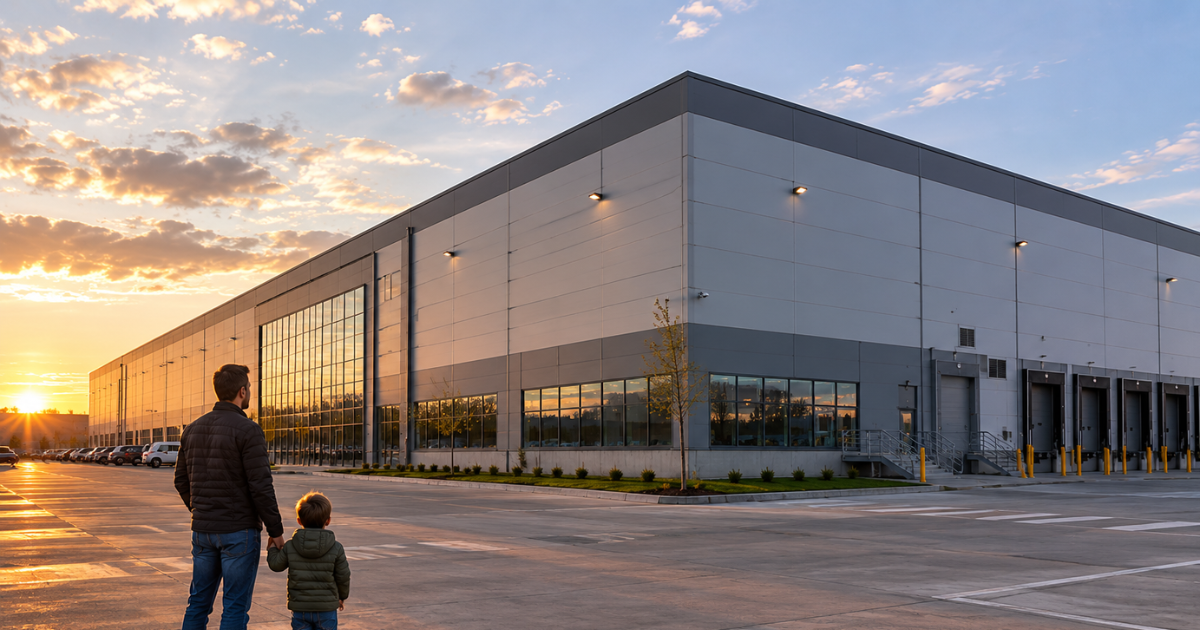
🔲 Why your building is a box, and why that is brilliant engineering.
🔲 Why peaked roofs stop making sense at a certain width.
🔲 Why Costco has ceilings tall enough to park a blimp.
🔲 What is actually holding your roof up right now.
— Elementary Level —
Start With a Cardboard Box
Hand a cardboard box to a six-year-old.
Flip it upside down. You just made a building.
Four walls. One cap on top. The cap keeps everything inside dry.
That is all a building is.
A box. Holding something valuable. Covered on top so the rain cannot ruin it.
Now here is the question Tommy asked on the drive home from school,
"Daddy, why does our house have a pointy roof but the Walmart doesn't?"
Great question, Tommy. Glad you are paying attention.
Why Houses Have a Peak
A peaked roof is smart. Rain and snow slide off. Water does not collect.
Houses are narrow enough to make that work. Most homes span 30 to 50 feet wide.
A triangle that wide is easy to frame. It is affordable. It is proven.
Imagine you and Tommy are building a fort out of two playing cards. Lean them against each other. They hold up just fine. That is a small peak.
Now try the same thing with two pieces of poster board. They flop. They sag in the middle. The bigger the span, the harder it is for a triangle to hold itself up.
That is the whole problem with putting a peak on a warehouse.
The bigger the building, the heavier the peak has to be.
Heavier means more wood. More steel. More money. More crane time.
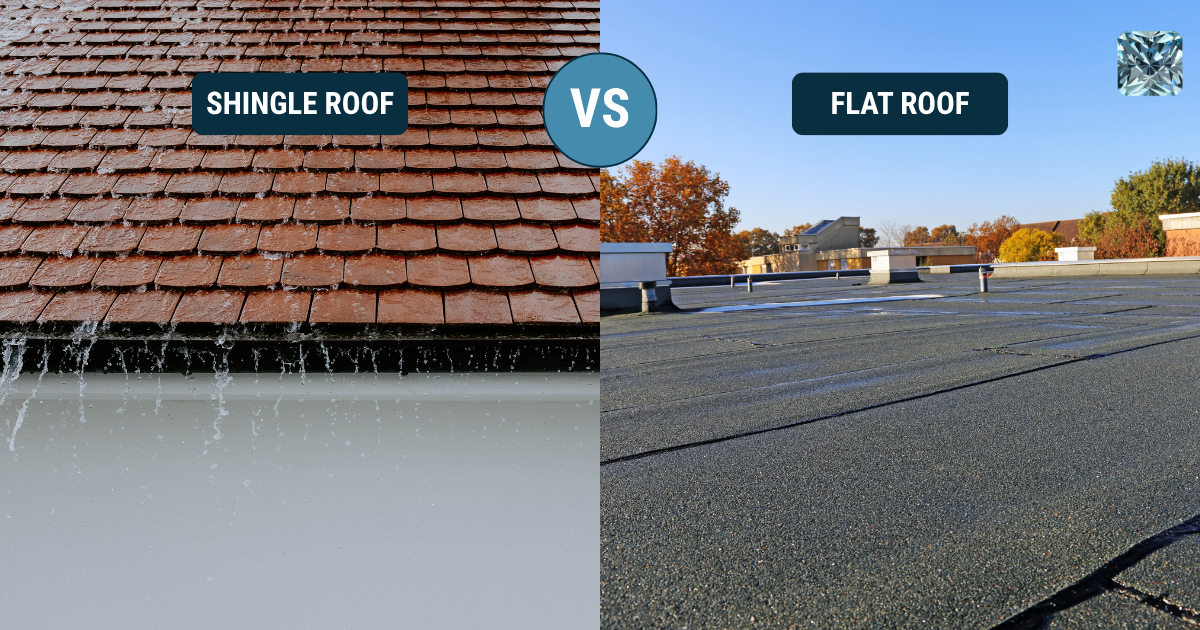
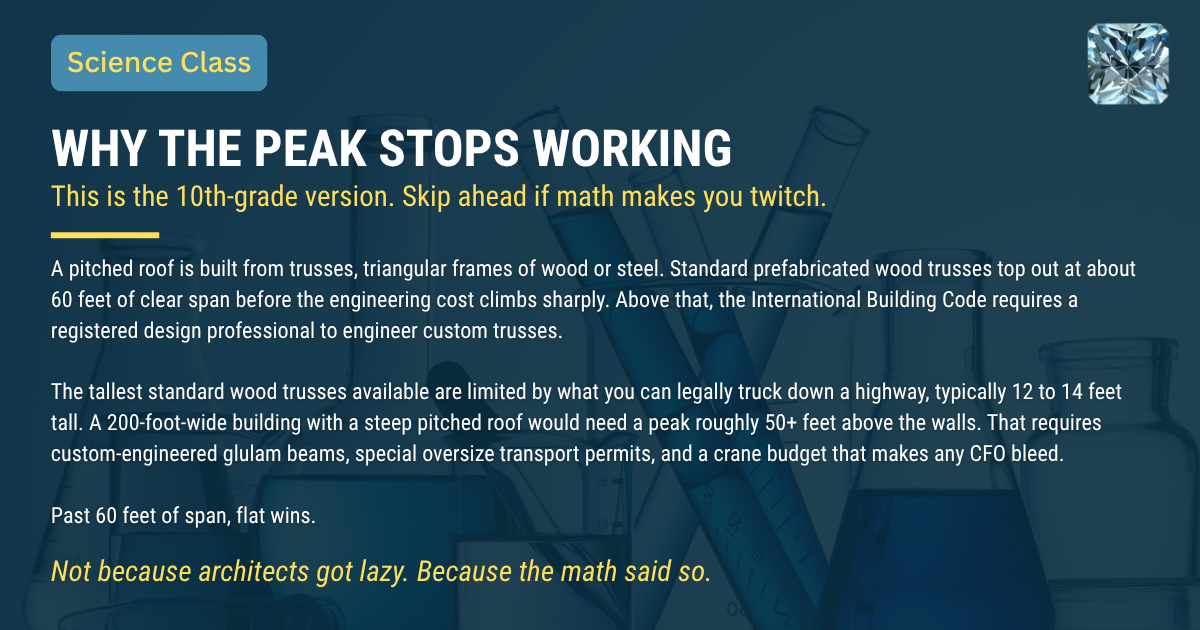
Somewhere around 60 feet wide, the math turns against the peak.
Past 60 feet, flat starts to win. Past 100 feet, flat wins by a mile.
What Holds Your Roof Up
Open up the ceiling at any big-box store and look up.
You will see a grid of zigzag steel triangles running the width of the building.
Those are called bar joists. Steel. Light. Strong. Factory-made.
They span from wall to wall in a straight line and carry the roof above them.
How far can they span?
- Standard K-series bar joists span up to 60 feet.
- Long-span LH series joists span up to 96 feet.
- Deep long-span DLH series joists span up to 240 feet.
They are the reason your building can be 300 feet wide with zero columns in the middle.
Tommy's question on the drive home, "So the building is held up by metal triangles?"
Yes, Tommy. The building is held up by metal triangles.
Specifically, hundreds of small triangles welded together into one big zigzag.
A zigzag is stronger than a straight beam because it spreads the load across many small pieces instead of concentrating it on one big piece. Triangles are the strongest shape in nature. Bridges use them. Cranes use them. Your building uses them too.
And above the joists sits the deck. Usually corrugated steel sheets.
Above the deck: insulation. Above the insulation: your roof membrane.
Four layers. Stacked. Each one doing a different job.
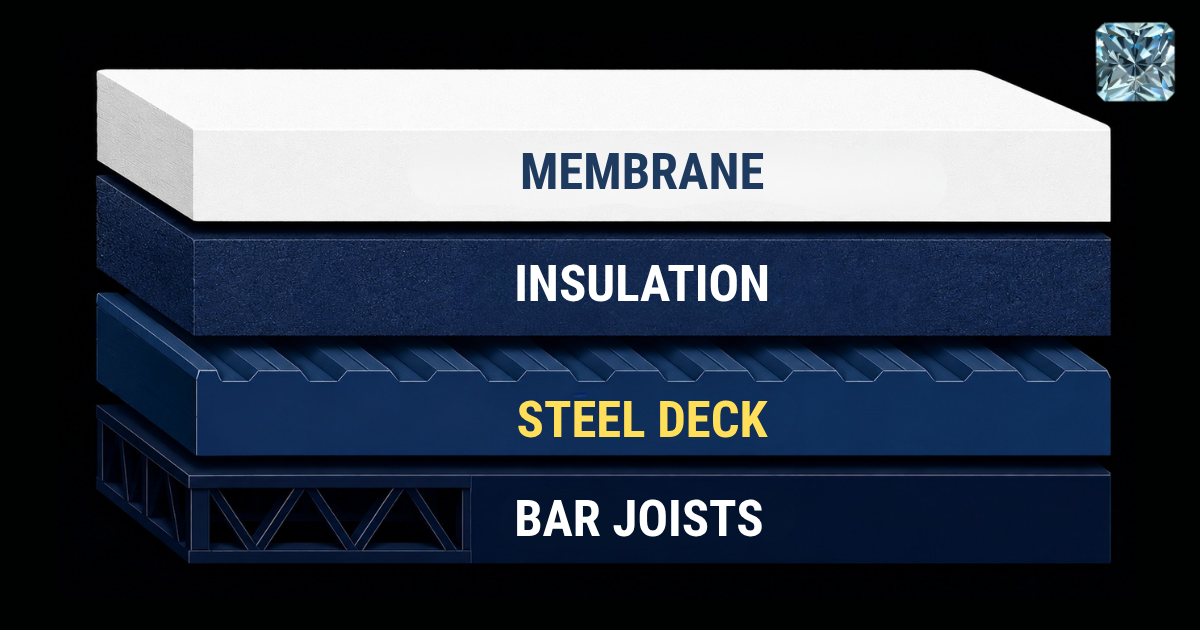

Read that bottom-up. The joists carry the deck. The deck carries the insulation. The insulation carries the membrane. The membrane keeps the water out.
Every layer above the joists is only there to protect the joists below.
Why Costco Is So Tall
Here is a question for the drive home: why do you feel so small inside a Costco?
Tommy already knows. Tommy is seven and Tommy goes, "It feels like an airport in there."
Tommy is right. It is built like an airport because it has to hold airport-sized stuff.
Three reasons. In order of importance.
- Pallet racks. Stack pallets six levels high and you need 30+ feet of clearance just for the product. Modern Class-A distribution centers run 32 to 40 feet of clear height. Costco is not being dramatic. Costco is being efficient.
- Fire code. Once warehouse storage exceeds about 30 feet of height, building code and the insurance carrier require Early Suppression Fast Response (ESFR) ceiling sprinklers. Those sprinklers need 12 to 18 inches of clearance above the highest stored item. That alone adds 4 to 5 feet to the required ceiling height before a single pallet goes up.
- Your brain. Research published in the Journal of Consumer Research (Meyers-Levy and Zhu, August 2007) showed that high ceilings trigger feelings of freedom and abstract thinking. Low ceilings trigger detail-focused, item-specific thinking. Costco wants you imagining the kayak in your garage — not scrutinizing the price tag.
So no, the architect was not being generous.
Every inch of that ceiling height is earning its rent.
Tommy on the drive home: "So Costco is tall because of forklifts, sprinklers, and brains?"
That is exactly right, Tommy.
Three reasons. Each one worth real money. Each one shaped a flat roof you could probably land a small helicopter on.
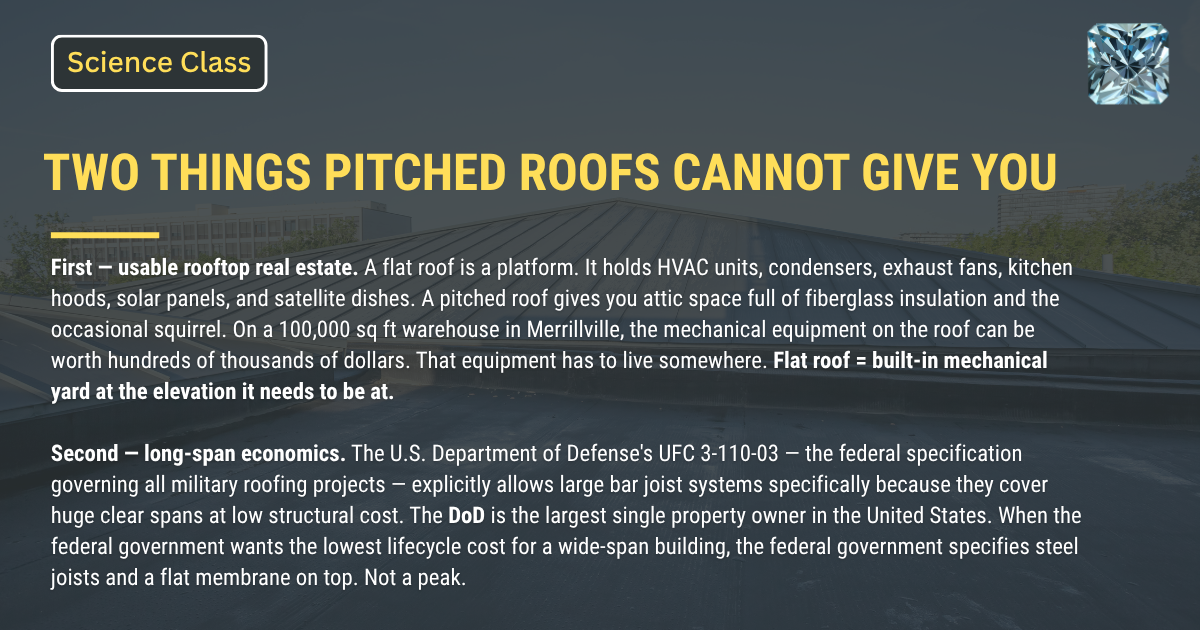
The Roof Has One Job
Stay dry.
Everything above your ceiling tiles, the bar joists, the deck, the insulation, has to stay dry to do its job.
The moment water gets in, the clock starts on decay.
Tommy's next question: "Why does water hurt the roof? Water is just water."
Good question, Tommy. Water hurts the roof three ways.
- Water makes steel rust. The bar joists holding up your whole building are made of steel. Rusted steel is weaker than fresh steel. Enough rust, the joist fails.
- Water makes insulation worthless. Wet insulation does not insulate. It just sits there, soaked, while your heat pours out through the roof and your utility bill quietly doubles.
- Water makes mold grow. Mold grows in dark, wet, warm places. The space between your insulation and your ceiling tiles is exactly that. Mold can shut down a building faster than fire.
So the roof has one job. Stay dry. The whole building depends on it.
And here is the catch with a flat roof: water does not naturally run off. It has to be coaxed.
The insulation is installed thicker at the edges and thinner toward the center drain, a subtle taper, like a very gentle hill.
Slightly slanted roofs last longer. Truly flat roofs collect problems.
The engineers figured this out. It took a few decades.
Kind of like seatbelts.
What's Actually On Most Lake & Porter County Roofs
Drive through any industrial park in Hammond, Hobart, Merrillville, Crown Point, Valparaiso, or Portage. Look up.
The roofs you see are mostly one of two things:
- Aging standing-seam or R-panel metal roofs.
- Expired single-ply rubber, usually black EPDM that has been baking in the sun since the 1990s.
Pristine has walked over 120 of these roofs across Northwest Indiana in the last few years.
The pattern is remarkably consistent.
Metal roofs fail at the seams and the fasteners first. The pretty paint chalks off. Rust starts where the protective coating wore through. The screws back out a quarter-inch at a time, year after year, until the rubber washer underneath stops sealing.
Rubber roofs fail at the glue first. The field rubber is usually fine. The seam tape and the perimeter adhesive, the stuff holding the whole thing together, that is what gives out.
Both can be restored with liquid roofing instead of replaced.
That is the entire subject of Articles 2, 3, and 4 in this series.
For now, the only thing you need to know is what is over your head right now, and how old it is.
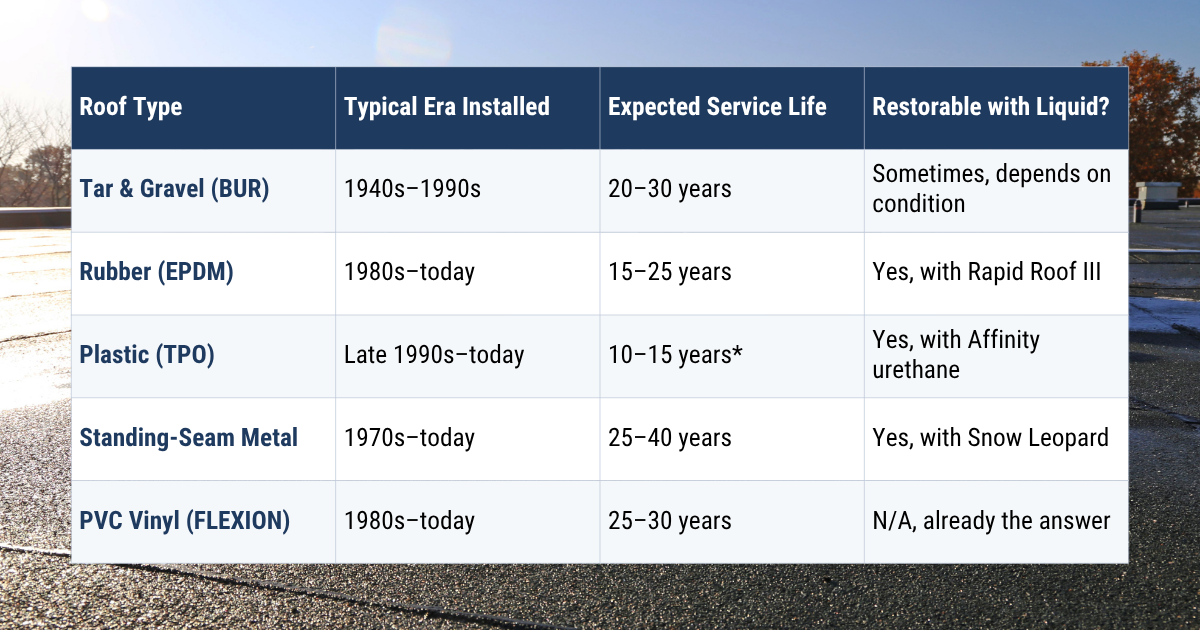
*The U.S. Department of Defense's UFC 3-110-03 specification restricts TPO to roofs with an anticipated life of 10 years or less. We will unpack that in Article 2.

What This Means for You
Three quick takeaways before you click to Article 2.
- Your building is flat because pitched roofs stop making economic sense above 60 feet of clear span. That is a structural decision, not an architectural one.
- The flat membrane on top of your building is one of five categories — tar, rubber, plastic, metal, or vinyl. Each one ages differently. Four out of five can be restored without a tear-off. The fifth is already the answer.
- If you do not know how old your roof is or what it is made of, that is the answer. The roof you cannot describe is the roof that is costing you the most in deferred maintenance.
When did someone last look at your roof?
If the answer is "I don't know", that is the answer. Pristine Industrial Roofing offers a full roof assessment: moisture mapping, membrane condition, drainage evaluation, and a written report. No tear-off pressure. No surprise invoices. Just information you need to make a smart decision.
Call or text: (219) 529-1995 • PristineIndustrialRoofing.com • Serving Lake County, Porter County, and Southwest Michigan.
Next: Article 2 — Tar, Rubber, or Plastic: Which One Is on Your Roof?
SOURCES CITED
U.S. Department of Defense. Unified Facilities Criteria 3-110-03, Roofing. 1 May 2012, with Change 5 dated 12 June 2020. Administered jointly by U.S. Army Corps of Engineers, Naval Facilities Engineering Command, and Air Force Civil Engineer Center. Approved for public release.
International Building Code. 2021 edition. Structural requirements for long-span truss systems and engineered framing above 60-foot clear spans.
Meyers-Levy, J., & Zhu, R. "The Influence of Ceiling Height: The Effect of Priming on the Type of Processing That People Use." Journal of Consumer Research, Vol. 34, No. 2 (August 2007), pp. 174–186.
Steel Joist Institute. Standard Specifications and Load Tables for K-Series, LH-Series, and DLH-Series Open-Web Steel Joists. Current edition.
PRISTINE INDUSTRIAL ROOFING
Lake & Porter Counties, Northwest Indiana • Southwest Michigan
(219) 529-1995 • BigRoofLibrary.com • ModernRoofChemistry.com
A Gospel Business — Profits Fund Worldwide Missions and Community Outreach
Read other blog:



We Love Conversations
 SoHelpful@PristineIndustrialRoofing.com