
What Should I Do Before I File a Commercial Roof Insurance Claim?
Storm damage documentation, wind damage inspection, and what building owners across the Region should do in the first days after a windstorm, before anyone calls the insurance company. The most expensive mistake in a roof claim usually happens before you ever pick up the phone.

1. Photograph everything before you clean up anything. Cleanup is the single most common reason a legitimate claim gets reduced.
2. Read your policy before you call. Not after. Your coverage was decided the day you signed, not the day the wind blew.
3. Do not let anyone on your roof who cannot show you a certificate of insurance and a license.
4. A tarp is emergency mitigation, not a repair. Document what was underneath it first.
5. Have someone who reads roofs standing beside you when the field adjuster arrives.
The wind came through the Region on a Tuesday and did not ask anybody's permission.
By Thursday morning more than a quarter million NIPSCO customers were still dark. The utility called it the largest and most widespread outage event on record in their service territory. Trees down across Munster and Griffith and Portage. Semitrailers on their sides. Gas stations run dry.
And on top of a few thousand commercial buildings, a whole lot of low slope roofing that is no longer sitting where it was on Monday.
Here is the part nobody tells you: your insurance claim is being decided right now, in these first few days, by things you are doing without thinking about them.
Not next month when the adjuster writes his report. Now. While you are cleaning up.
Why Are We Telling You This Instead of Selling You a Roof?
Because a building owner who understands his own claim is a better customer than one who doesn't, and because it's the right thing to do this week.
We are a commercial roofing contractor. We would like to work on your building. We are not going to pretend otherwise.
But right now half the Region does not have power, and a fair number of business owners are about to make decisions that will cost them tens of thousands of dollars, and they are going to make those decisions with no information at all. So here is the information. Use it with us, use it with somebody else, use it alone if you want to.
Just do not do nothing.
Number One: Photograph Before You Clean
Every hour of cleanup you do before documenting is money coming off the top of your settlement.
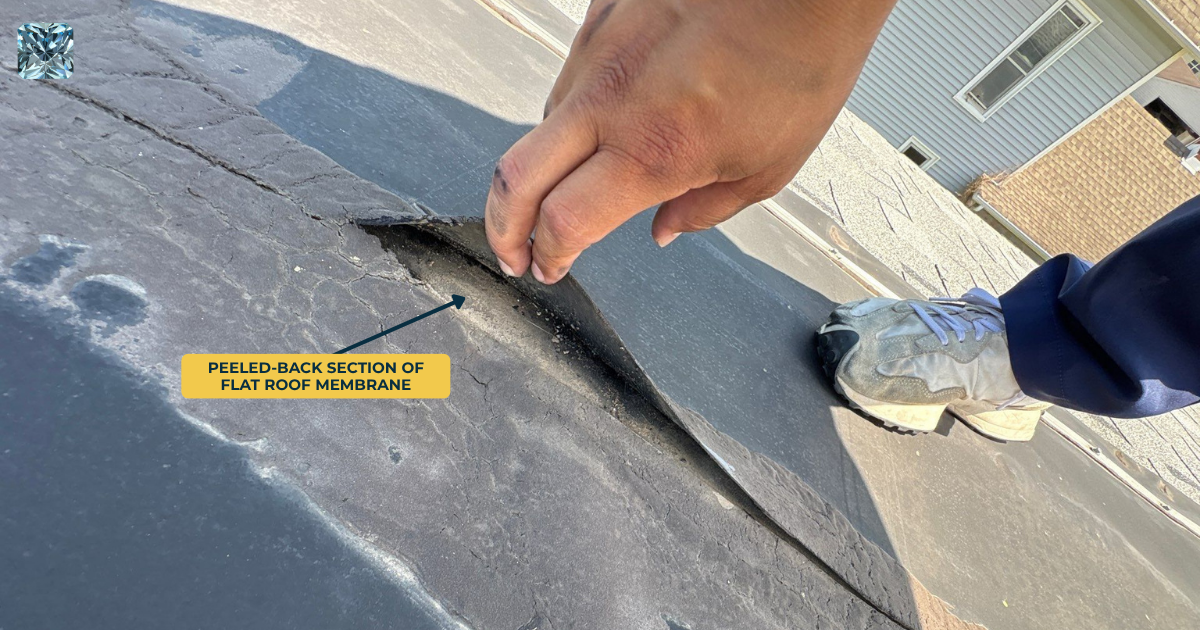
This is the one that hurts the most, because the people who lose the most money here are the responsible ones. The owner who got out there Wednesday morning with a crew and cleaned up his property is now in a worse position than the one who left it alone.
An adjuster prices what he can see and what you can prove. Debris on the ground is evidence. Displaced membrane flapping in the wind is evidence. Water on the floor under a ceiling grid is evidence. Once it is swept, hauled, mopped and dried, it is a story you are telling, and stories do not get paid at the same rate as photographs.
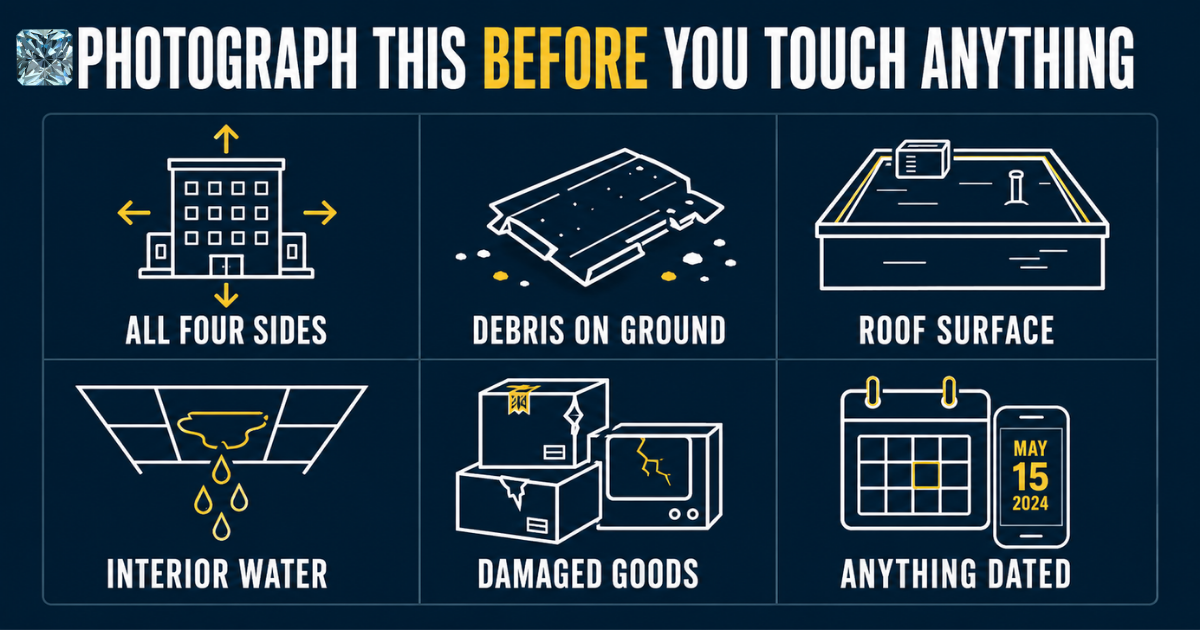
What to capture, before anything moves:
1. Wide shots of the building from all four sides, with a landmark visible for scale.
2. Every piece of roofing material on the ground, where it landed, before it is picked up.
3. The roof surface itself, if it is safe to be up there. If it is not safe, do not go up there.
4. Interior water damage, ceiling tiles, walls, flooring, and anything the water touched on its way down.
5. Damaged inventory, equipment, and product, individually.
6. Anything with a date on it. A newspaper, a phone screen, a timestamped photo app.
Take four times more than you think you need. Nobody in the history of insurance has ever regretted having too many photographs.
Number Two: Read Your Policy Before You Call
Your coverage was decided the day you signed. Reading it now only tells you what you already own.

Almost nobody reads a commercial property policy. It is long, it is dull, and it is written in a language that looks like English but is not.
Read it anyway. Before you call. Here is what you are looking for:
1. Your wind and hail deductible.
This is frequently a percentage of the building value rather than a flat dollar figure, and on a large building the difference is enormous. A man expecting a $2,500 deductible who finds out he has a two percent deductible on a four million dollar building is having a very bad afternoon.
2. Replacement cost versus actual cash value.
Replacement cost pays to put back what you had. Actual cash value pays depreciated value, which on a twenty-year-old roof is not very much. This single line decides whether your settlement is a roof or a down payment on a roof.
3. Ordinance and law coverage.
If code has changed since your roof went on, and in the Region it has, you may be required to bring the assembly up to current standards, including insulation values. Whether the policy pays for that upgrade is a separate coverage, and plenty of policies do not include it.
4. Your notice deadline.
Most policies require prompt reporting. Prompt is not defined the same way in every policy. Find your number.
5. Business interruption.
If you cannot operate, that may be covered separately from the building itself. A restaurant that cannot open is losing more per day than the roof costs.
You do not have to understand all of it. You have to know it exists, so that when someone tells you what you are owed, you have something to check it against.
Number Three: Be Careful Who You Let On Your Roof
The trucks with out-of-state plates in your parking lot did not drive nine hours because they care about the Region.

They are already here. They arrived before the power did.
Some of them are legitimate. Storm work is a real part of this trade and there are good companies who travel for it. But a share of them are not, and the ones who are not follow a pattern that is worth recognizing:
1. They knock unannounced and tell you they noticed damage from the road.
2. They want you to sign something on the first visit, often a contingency agreement that assigns them the work if the claim is approved.
3. They offer to handle the whole claim for you, or to cover your deductible.
4. They cannot produce a local address, a license, or a certificate of insurance when asked directly.
5. They want to get on the roof today, before anyone else sees it.
Ask three questions and most of the problem solves itself: Where is your office? May I see your certificate of insurance? Who is doing the work, your crew, or a subcontractor?
A contractor who cannot answer those three in ten seconds is not a contractor you want holding your building's future.
Number Four: A Tarp Is Not a Repair
Emergency mitigation protects the building. It also covers up the evidence, so document first.

Your policy almost certainly requires you to protect the property from further damage. That means tarping is not optional, if you leave water pouring into your building for three weeks, the insurer can decline the resulting damage as something you failed to prevent.
So tarp it. But do these two things in this order:
1. Photograph and video what is underneath, thoroughly, before the tarp goes on.
2. Keep every receipt. Emergency mitigation is usually reimbursable and it is separate from the roof settlement itself.
We are running tarp work across the Region right now. Everybody is. The good ones will document before they cover. If your tarp crew did not take pictures first, take them yourself before they finish.
Number Five: Do Not Meet the Adjuster Alone
He is doing his job. His job is not the same as your interest.
The field adjuster who comes to your building is a professional doing professional work, and most of them are decent people. That is not the issue.
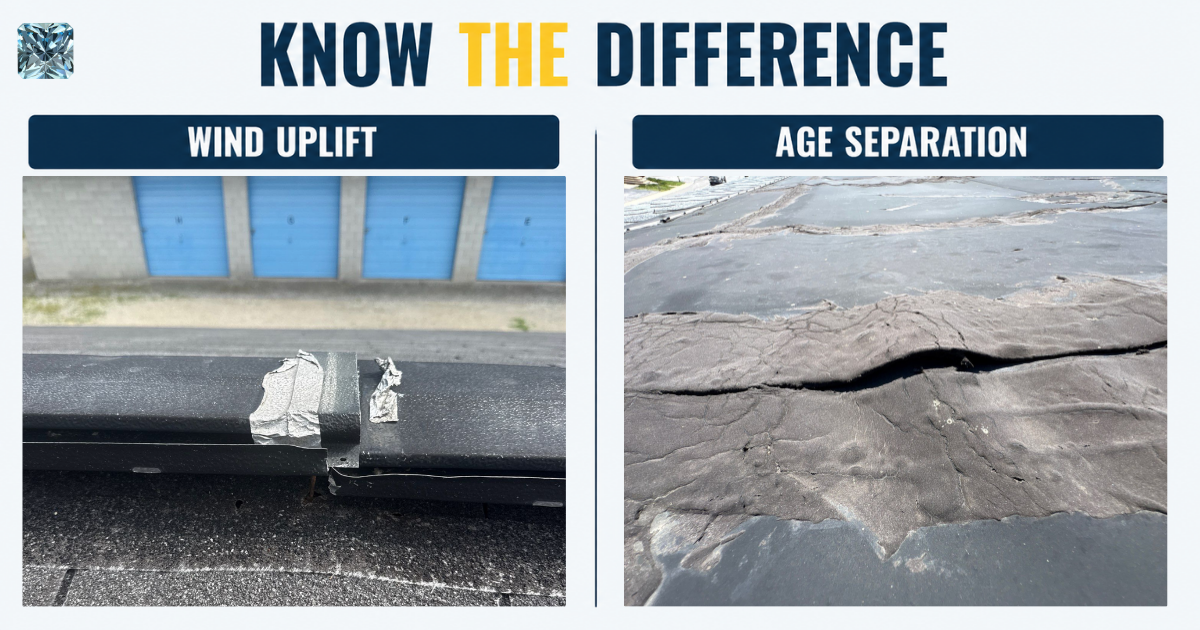
The issue is that he reads roofs for a living and you do not. He knows what wind uplift looks like at a seam and what it looks like when a membrane has simply aged out. He knows which of those his company pays for. If you are standing beside him nodding, you are agreeing to a scope you cannot evaluate.
Have somebody with you who reads roofs. A contractor. A licensed public adjuster. Somebody. This is the whole reason our field people show up for adjuster meetings on buildings we have not been hired for yet.
Questions People Are Asking This Week
Q: How long do I have to file a claim after a windstorm?
A: Most commercial policies require prompt notice and give you a longer window to complete the claim itself. Find the specific language in your policy — the requirement is not identical across carriers, and missing it is the easiest way to lose a valid claim.
Q: Should I file if I am not sure the damage is bad enough?
A: Get the roof looked at by somebody qualified before you decide. A claim that gets filed and then withdrawn or denied still shows up in your history. A roof that gets inspected and turns out fine costs you nothing.
Q: My roof is not leaking. Do I still have damage?
A: Frequently, yes. On a low slope roof, wind damage often shows up as lifted seams, displaced flashing, missing coping cap, or membrane that has been stretched and released. None of that leaks on day one. It leaks in November, after the deductible clock has run out.
Q: Can I switch to a different roof system if my claim is approved?
A: Often you can, though it depends on your policy and how the scope is written. This is a conversation worth having before the settlement is finalized rather than after, because a storm is one of the few moments when upgrading the assembly costs you very little.
Q: Does my roof warranty cover storm damage?
A: Almost never. Manufacturer warranties generally exclude acts of nature, which is exactly what this was. Storm damage is an insurance question, not a warranty question, and the two are frequently confused in the same phone call.
What Happens Next
Power comes back across the Region between now and the twenty-first, according to NIPSCO. Somewhere in there you are going to walk your roof, or have someone walk it for you, and find out what you are actually dealing with.
Before that happens, do the five things at the top of this page. They cost nothing and they take an afternoon.
If you want somebody to walk the roof with you, we will do it whether or not you hire us, and we will tell you if there is nothing there. There are only so many of us and a great many buildings, so we are going in order.

The Short Version for Bill
Take pictures before you clean. Read your deductible. Do not sign anything on a first visit. Document under the tarp before it goes on. Do not meet the adjuster by yourself.
Related Reading
1. Does My Flat Roof Qualify For A Wind Claim?
2. Don't File That Wind Claim Until You Read This
3. The Insurance Red Flag Hiding in Your Roof Coating History
4. Your Insurance Agent Is Not Your Claims Advocate
We Love Conversations
Pristine Industrial Roofing — Hobart
Serving Lake, Porter, LaPorte, Jasper and Newton counties.
Conklin certified. BBB accredited. Commercial and industrial low slope only.
Pristine is a Gospel business. Proceeds fund community outreach and worldwide missions.
Read other blog:

We Love Conversations
 SoHelpful@PristineIndustrialRoofing.com