
What Is Liquid Roofing and How Does It Actually Cure?
It arrives in a tote. It goes on like paint. Then chemistry happens. When it is done, you have a seamless skin over your entire roof. No seams. No glue. No gaps. No guessing.
🔲 The difference between liquid roofing and rolled membrane, once and for all.
🔲 How acrylics cure (it is not magic, it is evaporation).
🔲 How urethanes cure (it is chemistry, and it is stronger).
🔲 Why Conklin invented this category in 1977, and still leads it 49 years later.
— Let's Clear Up the Biggest Confusion in This Industry —
Liquid Is Not PVC. PVC Is Not Liquid.
This gets mixed up constantly. Even inside roofing crews.
So let us settle it right here before we go any further.
PVC, polyVINYL chloride, is a flexible solid. It arrives on a pallet. In rolls. Already cured.
Crews unroll it, overlap the edges, and weld the seams with a heat gun that looks like a flat iron on wheels.
It does not cure on the roof. It is already done when it arrives.
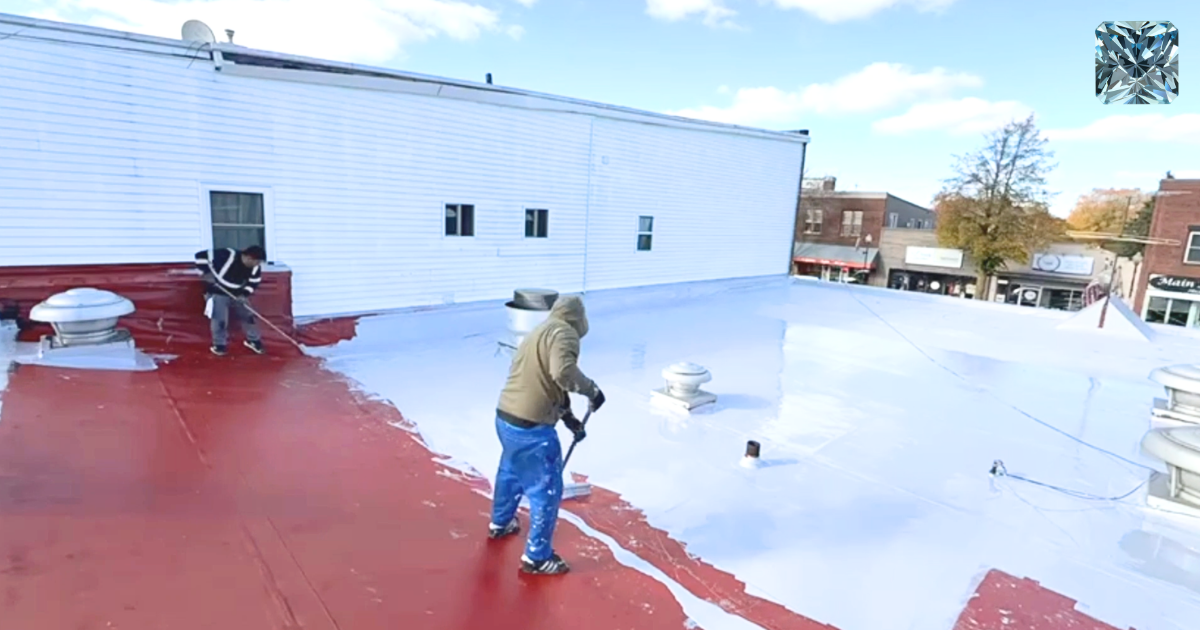
Liquid roofing arrives in a 220-gallon tote. It is applied through a commercial sprayer.
It cures on your roof. On your building. Bonded to your specific surface.
Monolithic. Edge to edge. No seams. One continuous membrane.
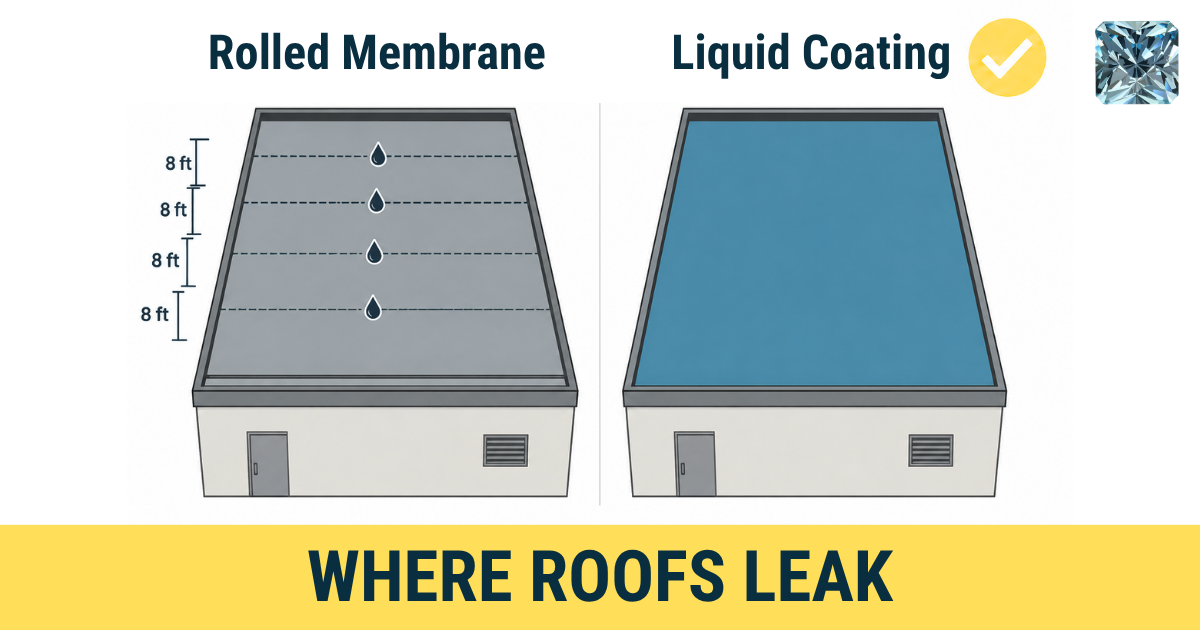
Liquid has zero seams. Rolled sheet systems have a seam every 6 to 10 feet.
Seams are where roofs leak. Do the math.
Tommy on the drive home: "So PVC is like a giant sticker for the roof, and liquid is like spray paint?"
That is a perfect analogy, Tommy. PVC is a giant sheet sticker. Liquid is spray paint that gets nine times thicker than house paint and stretches six times its own length before it tears.
Both can be the right answer depending on the building. But they are not the same product, and they are not the same chemistry.
How Liquid Roofing Arrives on Your Roof
It comes in a 220-gallon tote box on a pallet.
Standard paint sprayers cannot move material this thick. The viscosity would burn out a regular pump in 20 minutes.
Professional crews use Graco commercial sprayers with in-line heaters.
Tommy on the drive home: "They heat the paint up?"
Sort of, Tommy. The material is warmed up as it goes through the hose.
Hot application gives better bonding to the existing roof, faster cure time once it is down, and more even coverage so we don't waste material.
Cold application is old-school. Heated application is where the industry is now.
Think of it like the difference between cold honey and warm honey. Same material. Very different behavior. Warm honey pours. Cold honey clogs.
— Elementary Level —
Acrylic: Water Leaves. Chemistry Stays.
Acrylic coating is a water-based emulsion, millions of tiny polymer beads floating in water.
When it goes on a warm Lake County roof, the water evaporates up into the atmosphere.
The beads get pushed closer together. They fuse. That process is called coalescence.
What is left behind is a continuous, flexible membrane bonded directly to your roof.
No chemical reaction. No UV trigger. Just water leaving and polymers hugging.
Tommy on the drive home: "So the water just flies up into the sky?"
Pretty much, Tommy. The water evaporates into the air. The tiny plastic beads it left behind squish together into one continuous flexible skin.
That is why we cannot put acrylic down if it is going to rain that night. The water has to have time to leave before more water shows up.
Conklin acrylic systems need above 40°F for at least 24 hours after install.
Apply it the evening before a thunderstorm and you wash a thousand dollars off the roof.
Northwest Indiana contractors learn this lesson exactly once.

📥 DOWNLOAD THE SPEC SHEET: SNOW LEOPARD (PUMA XL) — The Metal Roof's Best Friend
Polyurethane-modified acrylic. 250% elongation. Solar reflectance 0.85. Two warranty lanes: 10-year metal restoration system, or 20-year full Spunflex 2.0 system over expired TPO.
→ Click here to download (PDF)
Pristine has installed two Conklin acrylic systems all over Lake and Porter County. Each one does a different job:
- Snow Leopard — for metal roofs. Bright white. Reflective. Bonds molecularly to standing-seam metal, R-panel, and corrugated. The default solution for the most common roof in Northwest Indiana.
- Rapid Roof III — for legacy EPDM rubber. Both coats stretch 300%, which is more elastic than the rubber underneath. The product Conklin invented in 1977, refined for three generations.
📥 DOWNLOAD THE SPEC SHEET: RAPID ROOF III — The EPDM Restoration Specialist
49 years of field-proven performance since 1977. Acrylic elastomeric, 300% elongation both coats. Spunflex-reinforced seams. The original cool roof system, refined for three generations.
→ Click here to download (PDF)
Urethane: Chemistry Marries Chemistry
Urethane is a completely different animal. It does not dry. It reacts.
Two-component urethane: Part A and Part B are mixed at the job site. They react together to form long, cross-linked polymer chains. Once mixed, the clock is running, you have a limited "pot life" before the bucket becomes a brick.
Moisture-cure urethane: a single-component product that pulls water vapor out of the air to trigger the same reaction. More humidity equals faster cure. Northwest Indiana summers are a moisture-cure urethane's dream.
Tommy on the drive home: "So acrylic is like glue that dries, and urethane is like glue that mixes?"
Yes Tommy. That is exactly right.
Acrylic is patient. It waits for the water to leave.
Urethane is impatient. It reacts the moment Part A and Part B touch each other.
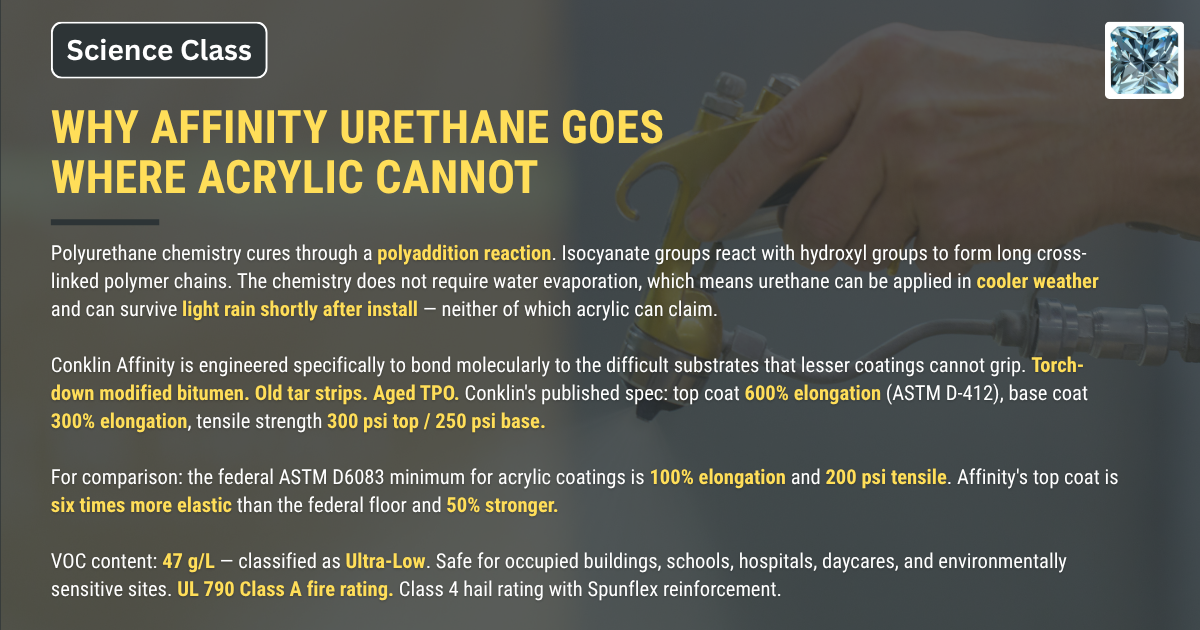
Conklin's Affinity urethane system goes on in three coats,
- A red bonding primer — grips chemically to existing surfaces: torch-down bitumen, tar strips, legacy EPDM, expired TPO, and metal.
- A battleship-grey aromatic urethane base coat — built for foot traffic, impact resistance, and hard wear.
- An aliphatic urethane top coat — UV-stable, holds its white color, and makes sunlight bounce away.
Bottom line: acrylic equals water leaves. Urethane equals chemicals marry.
Two mechanisms. Two installation windows. Two price points. One result: a seamless membrane that outlasts the rolled stuff it replaces.
📥 DOWNLOAD THE SPEC SHEET: AFFINITY — The Urethane Coating System
Polyurethane chemistry. 600% top coat elongation. Bonds molecularly to torch-down, tar strips, expired TPO, legacy EPDM, and metal. 20-year non-prorated warranty. Class 4 hail with Spunflex reinforcement.
→ Click here to download (PDF)

How Thick Is It When It's Done?
A mil is one-thousandth of an inch.
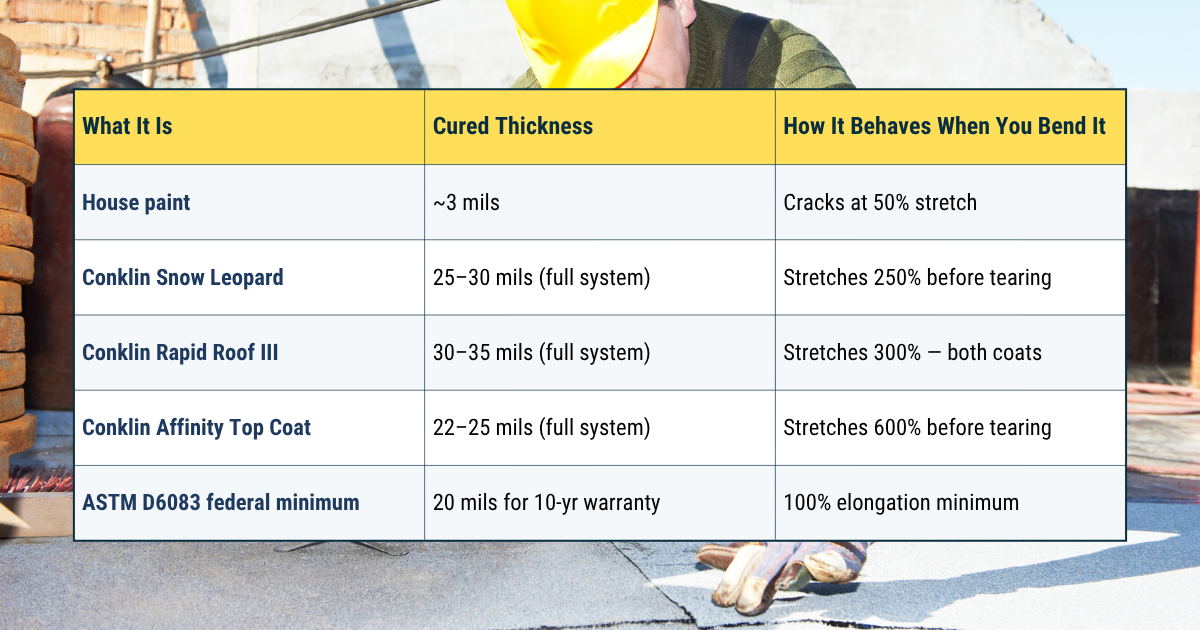
Your house paint dries to about 3 mils. A liquid roof system cures to 25 to 35 mils.
Seven to ten times thicker than house paint. Engineered to flex, not just look good.
Tommy on the drive home: "So my roof is like having ten coats of house paint on it?"
Better than that, Tommy. The chemistry is different. House paint hardens. Roof coating stretches.
If you stretched house paint 100 percent it would crack. Affinity stretches 600 percent before it tears. Snow Leopard stretches 250 percent. Rapid Roof III stretches 300 percent.
The gap between wet thickness and dry thickness is called percent volume solids.
If a product is 55% solids, 45% of what you sprayed, mostly water, evaporates away.
So you have to apply more wet material to achieve the required dry thickness.
Tommy on the drive home: "Why don't they just sell us the dry part?"
Honest answer, Tommy: because we need the wet part to spread it on. The water is the delivery truck. Once the polymer beads get to the roof, the delivery truck drives off into the sky.
This is why the federal ASTM standard cares so much about volume solids. A higher solids percentage means more cured roof per gallon, and less of the building owner's money floating off as vapor. The handyman bucket from the hardware store is usually around 40% solids. Conklin systems run 50% to 70% solids. That difference is the difference between a roof and a paint job.
A 10-year warranty typically requires 20 dry mils. A 20-year warranty requires 30 dry mils.
If a contractor quotes a coating job without specifying dry-mil thickness, ask. That number is everything.
Conklin Invented This Category. In 1977.
The Conklin Company was trying to develop a durable red barn paint for the farming community.
Happy accident: they invented the commercial acrylic elastomeric roof coating instead.
They called it Rapid Roof. They launched it in 1977.
That is 49 years of continuous field performance. Over 2 billion square feet of American commercial roofs installed.
The material failure claim rate over those 49 years: 0.05 percent.
One Conklin Master Contractor in Scottsdale, Arizona shared a project profile: a property addition where a Rapid Roof system stayed leak-free for 30+ years on minimal maintenance. The main shingled roof of the same building had been replaced twice during the same window because of hail and wind damage.
The coating outlasted two full shingle replacements right next to it.
Here is the kicker most building owners never hear: Menards installs Conklin systems on their own buildings — while selling lesser materials to DIY shoppers.
Make of that what you will.
When somebody calls liquid roofing "new" or "unproven," they are misinformed or they are selling you something else.
The chemistry is older than the iPhone, the minivan, and most facility managers reading this article.
Liquid roofing is not for every roof. But it might be for yours.
If your current membrane is serviceable and the insulation is dry, a liquid restoration system can add 15 to 20 years of life at a fraction of the cost of a full replacement. The math is not complicated. Let us walk your roof. We will tell you which category you are in. Honestly.
Call or text: (219) 529-1995 • PristineIndustrialRoofing.com • Serving Lake County, Porter County, and Southwest Michigan.
Next: Article 4 — Should You Restore or Replace Your Commercial Roof?
SOURCES CITED
ASTM International. ASTM D6083/D6083M-24, Standard Specification for Liquid-Applied Acrylic Coating Used in Roofing. Minimum performance thresholds for tensile strength, elongation, weathering, tear resistance, and low-temperature flexibility.
ASTM International. ASTM D-412, Standard Test Methods for Vulcanized Rubber and Thermoplastic Elastomers — Tension. Reference standard for elongation and tensile strength measurements cited on Conklin spec sheets.
Cool Roof Rating Council. Third-party verified solar reflectance, thermal emittance, and SRI ratings for Conklin Snow Leopard (Puma XL), Rapid Roof III, and Affinity Urethane.
Conklin Company. Product specification sheets and historical record: Rapid Roof (1977 launch — first acrylic elastomeric coating in America), Rapid Roof III, Snow Leopard / Puma XL, Affinity Urethane Coating System. Conklin Company, Kansas City, Missouri.
U.S. Department of Defense. UFC 3-110-03, Roofing. Section 2-8 guidance on liquid-applied roof coating systems and Mesh Reinforced Elastomeric Roof Coatings (MREC). 1 May 2012, with Change 5 dated 12 June 2020.
PRISTINE INDUSTRIAL ROOFING
Lake & Porter Counties, Northwest Indiana • Southwest Michigan
(219) 529-1995 • BigRoofLibrary.com • ModernRoofChemistry.com
A Gospel Business — Profits Fund Worldwide Missions and Community Outreach
Read other blog:


We Love Conversations
 SoHelpful@PristineIndustrialRoofing.com