
What Are the Top Three Mistakes to Avoid When Filing a Commercial Roof Claim?
Why commercial wind damage claims get denied, what a field adjuster is actually looking for, and how building owners across the Region protect their payout after a windstorm. Your adjuster is not your enemy. But he is not your advocate either, and somebody in that room should be.
1. Talking too much. Answer what you are asked, accurately. Do not guess out loud about causes you are not qualified to determine.
2. Not knowing the language. Insurance is a contract negotiation wearing a construction costume. The words have specific meanings and they are not the ones you assume.
3. Going it alone. If you do everything yourself, you get do-it-yourself results.
4. None of these three are about the roof. All three are about the conversation.
There is a right way and a wrong way to file a roof claim, and most business owners find out which one they picked about six weeks too late.
We have watched it happen enough times now that the pattern is boring. Same three mistakes, over and over, made by intelligent people who run successful companies and have simply never had a reason to learn this particular skill.
Nobody teaches you this. There is no class. You get one shot every fifteen or twenty years and you are expected to be good at it.
Mistake One: Saying Too Much
Answer the question that was asked. Resist the urge to fill the silence.

We are all good at pointing out problems. It is the easy part of being a building owner, you know every flaw in your property and you have been meaning to get to half of them since 2019.
So the adjuster shows up, and the nervousness kicks in, and you start narrating. The drain has always been slow. That corner has leaked on and off for years. We had a guy patch it a while back and I do not think he did it right. The roof is getting old anyway.
Every one of those sentences is a gift to the person deciding whether to pay you.
Here is the honest way to think about this, and we want to be careful, because there is a wrong version of this advice floating around out there.
The Line That Matters
You must answer every question truthfully and completely. Never conceal anything an adjuster asks about. That is not a strategy, it is fraud, and it will void your claim faster than anything on this page.
What you should not do is speculate. You are not a forensic engineer. When you guess out loud about why something failed, you are not being honest, you are being imprecise, and your guess goes in the file as though it were a finding.
The right answer to a question you do not know the answer to is: I don't know, our roofing contractor can speak to that.
That is not withholding. That is deferring to someone qualified, which is what you would do about anything else in your business.
You would not diagnose your own equipment failure to a manufacturer's rep. Do not diagnose your own roof to an adjuster.
Mistake Two: Not Knowing the Language
Insurance is not primarily about construction. It is a negotiation over the meaning of preset terms.
Your policy already told you exactly what you get. It told you the day you signed it. The claim process is not a decision about what you deserve, it is an argument about what the words in that document mean when applied to your building.
And you cannot read the language. Not because you are not smart. Because it is a specialized vocabulary and nobody handed you the glossary.
A short sample of terms that will decide your settlement:
1. Cosmetic damage. Damage that affects appearance but allegedly not function. Some policies exclude it outright. On a metal roof or a coping cap, whether something is cosmetic or functional is worth a great deal of money and is genuinely arguable.
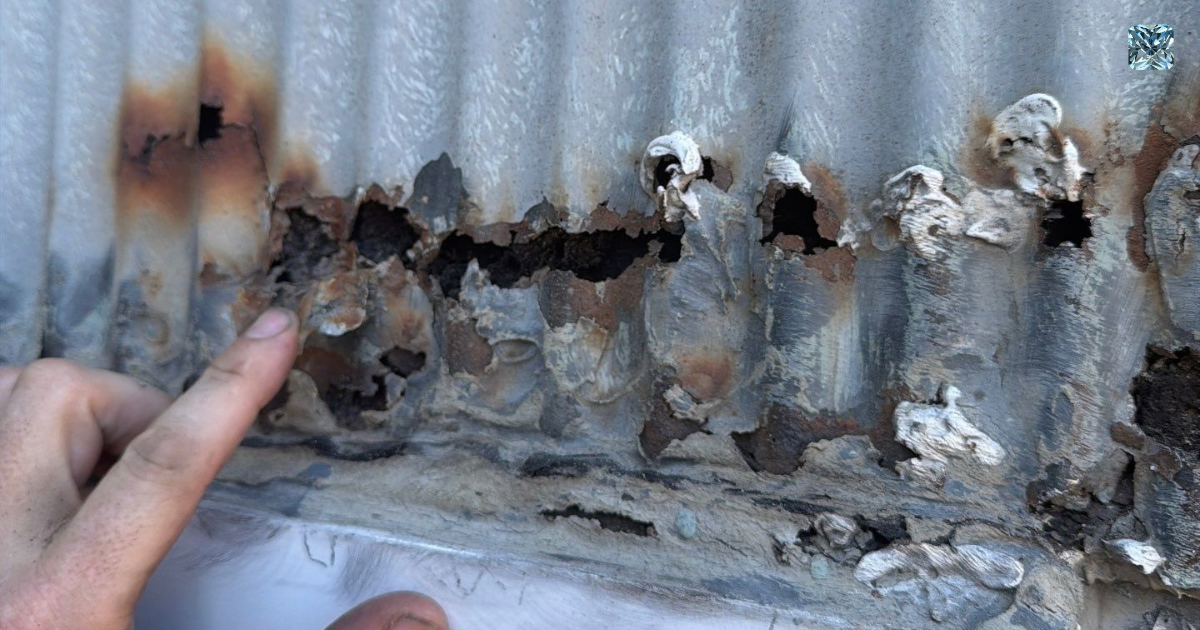
2. Wear and tear. The universal denial. Everything on a twenty-year-old roof can be attributed to age by someone motivated to attribute it to age. Distinguishing storm damage from age is the entire fight.
3. Code upgrade. If current code requires more insulation than your roof has, replacing it means adding insulation. Whether that is covered depends on ordinance and law coverage, which is separate.
4. Matching. If a damaged section cannot be matched to the undamaged sections, some policies require replacement of the whole. Some do not. This one line can be the difference between one roof section and the entire building.
5. Recoverable depreciation. Money held back until the work is complete. If you do not know it exists, you may never claim it, and the carrier is not going to send you a reminder.
Five terms. Any one of them can move a settlement by five figures.

Mistake Three: Going It Alone
If you do everything yourself, you get do-it-yourself results.

This is the one that genuinely bothers us, because it is the most fixable and the most common.
A business owner files his claim alone, meets the adjuster alone, accepts the scope alone, and calls a contractor only after the check clears. Then he finds out the check covers about forty percent of a roof, and the conversation that could have changed that happened three weeks ago in a parking lot he attended by himself.
You do not get what you deserve. You get what you documented, argued, and asked for.
What an advocate actually does in that meeting is not adversarial and it is not dramatic. It is mostly this: he sees things on the roof that you do not see, he knows what they are called, and he says the name out loud while the adjuster is writing.
Seam uplift. Rip curl at the edge. Water incursion under the membrane. Displaced coping. Stretched and released field membrane. Those are not magic words, they are just the correct words, and the correct word gets written down.
What We Are and What We Are Not
We are your advocate. We are not attorneys and we are not a public adjusting firm.
We read roofs, we document what we find, we stand in the meeting, and we say what things are. When a claim needs a licensed public adjuster or legal help, we will tell you that and point you toward it.
Why This Storm Is Different for Low Slope Buildings
Wind does not damage a flat roof the way it damages a sloped one, and that is exactly where claims go sideways.
Everybody's mental picture of storm damage is shingles in the yard. That is a house problem, and we do not work on houses.
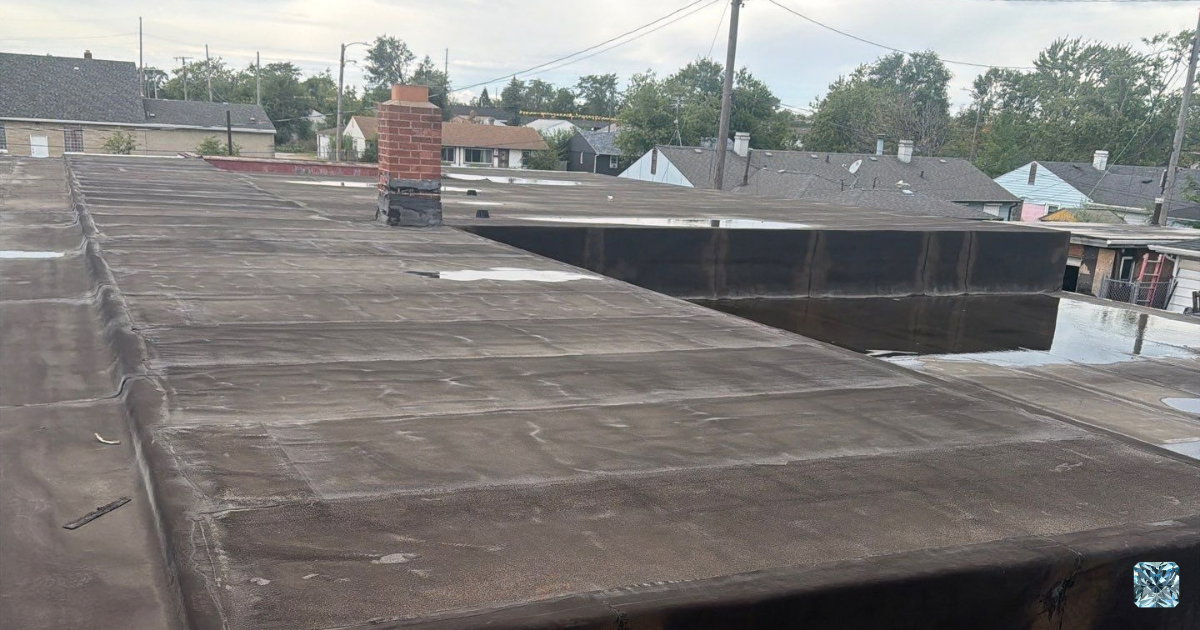
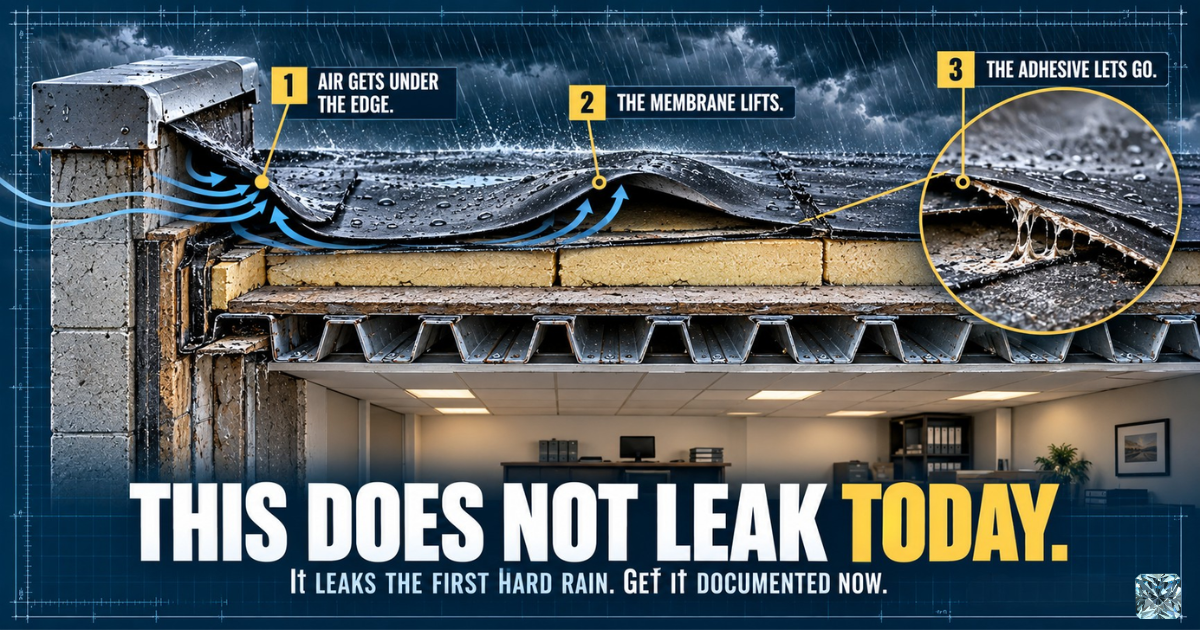
On a low slope commercial roof, wind does something less visible and more expensive. It gets under an edge, lifts, and lets go. It does that a few thousand times in twenty minutes. What is left behind is a membrane that looks broadly intact from the parking lot but has been peeled and reset at every seam, with the aging adhesive on the old rubber systems giving up first.
The thin plastic sheet goods and the tired rubber membranes both fail this way, and they both fail quietly. Nothing leaks on the day of the storm. It leaks the first hard November rain, at which point the carrier has an excellent argument that whatever happened, happened in November.
This is why you get the roof documented now, even if it is not leaking. Especially if it is not leaking.
Questions We Are Getting on the Phone
Q: Will filing a claim raise my premium?
A: It can, and anyone who promises otherwise is guessing. What is also true is that an unrepaired roof will eventually cost more than a premium increase, and carriers have been known to non-renew buildings with deferred roof problems. Weigh both, and talk to your agent about your specific situation.
Q: The adjuster said it was wear and tear. Is that the end of it?
A: No. An initial determination is a position, not a verdict. Supplements and re-inspections are a normal part of this process, and a documented second opinion from a qualified contractor is how most of them get reopened.
Q: What if the settlement does not cover a full roof?
A: That is common and it is not always the end. It usually means the scope was written narrowly, and scope is negotiable when it is supported by documentation. It can also mean your policy pays depreciated value, in which case the math is the math.
Q: Do I have to use the contractor my insurance recommends?
A: Generally no. In most cases you choose your own contractor. A carrier-preferred vendor works within pricing agreements with the carrier, which is worth understanding before you assume the recommendation is neutral.
Q: Can I just get it patched for now?
A: You can, and sometimes you should. But understand that once the claim is settled and closed, a patch is what you bought. Decide whether you are patching a roof or patching a claim.
What Happens Next
Over the next several weeks a very large number of buildings across the Region are going to be inspected, scoped, argued over, and settled. Most of that will happen fast, because there is a great deal of it and everyone is in a hurry.
Fast is where money gets left behind.
Take the extra afternoon. Read the policy. Get a second set of eyes on the roof. Have somebody in the meeting who has read a thousand of them.
We will walk your roof and tell you what we see, whether or not you hire us, and whether or not there turns out to be a claim in it. That offer is not a sales tactic, it is just what a neighbor does in a week like this one.

The Bottom Line
The three mistakes have nothing to do with roofing. They are all about the conversation: saying more than you know, not knowing what the words mean, and having that conversation by yourself.
Fix those three and you are not gaming anybody. You are just showing up prepared to a negotiation you did not ask to be in.
Related Reading
1. Commercial Roof Insurance Terms Every Property Owner Should Know
2. Your Insurance Agent is Not Your Claims Advocate
3. What Should I Do Before I File a Commercial Roof Insurance Claim?
4. What Wind Really Does to Your Flat Roof During a Severe Storm
We Love Conversations
Pristine Industrial Roofing — Hobart
Serving Lake, Porter, LaPorte, Jasper and Newton counties.
Conklin certified. BBB accredited. Commercial and industrial low slope only.
Pristine is a Gospel business. Proceeds fund community outreach and worldwide missions.
Read other blog:


We Love Conversations
 SoHelpful@PristineIndustrialRoofing.com