
Tar, Rubber, or Plastic: Which One Is on Your Roof?
Three materials have dominated flat roofing for 80 years. One is ancient. One is tired. One was never meant to last. You probably have one of them. Let's figure out which.
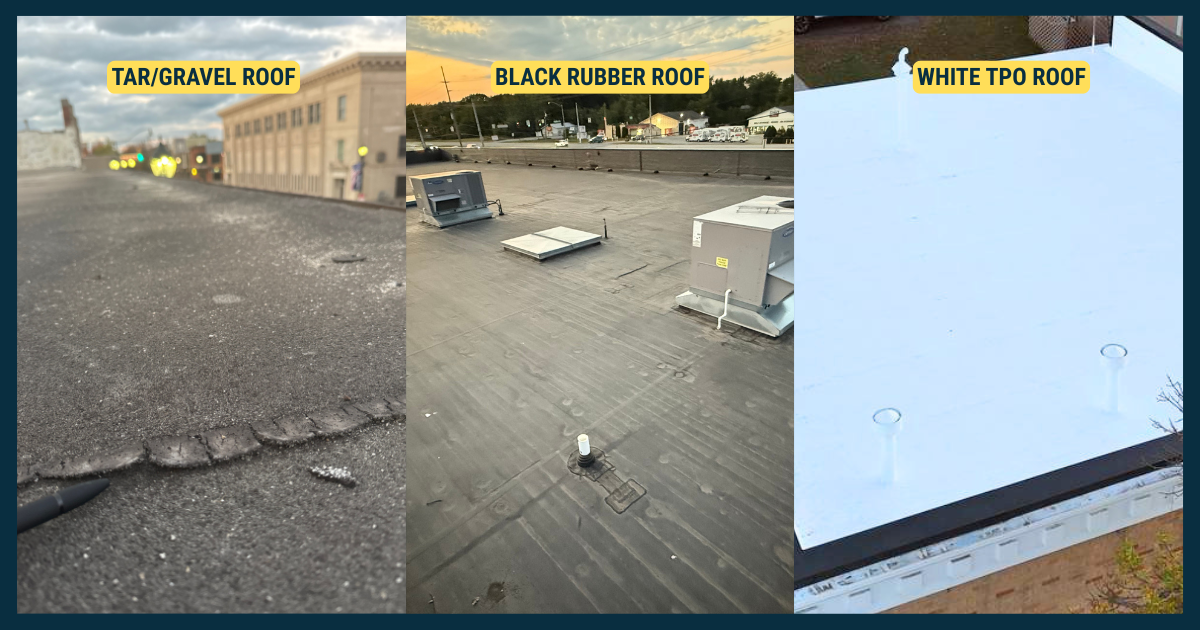
🔲 The honest history of flat roofing, tar to today.
🔲 Why rubber seams expire, and what happens when they do.
🔲 Why plastic got popular (hint: it was cheap, not smart).
🔲 What the U.S. Department of Defense actually says about TPO.
— Elementary Level —
Three Options. One Roof. Which Is Yours?
Go outside. Look up.
Your commercial roof is probably one of three things: tar, rubber, or plastic.
Each one had its moment. Each one has its problems.
Let us walk through them like you are explaining it to your kid on the drive home from school.
Tar Came First
For most of the 1900s, flat roofs were built up with layers of tar and felt.
Hot tar. Mop. Repeat. Gravel thrown on top to hold it all down.
Simple. Heavy. Proven.
Tommy on the drive home: "So they just poured hot tar onto buildings?"
Yes, Tommy. They literally heated tar in a kettle on the roof and mopped it on. Then they sprinkled gravel on top like cake sprinkles, except the cake was your warehouse and the sprinkles weighed two tons.
In the 1940s and 50s, truly flat roofs were common. No slope at all.
Rain had nowhere to go. It just sat there.
A puddle became a pond. A pond became a lake. A lake became a collapse.
Slowly, the industry learned: every flat roof needs a taper. Water has to go somewhere.
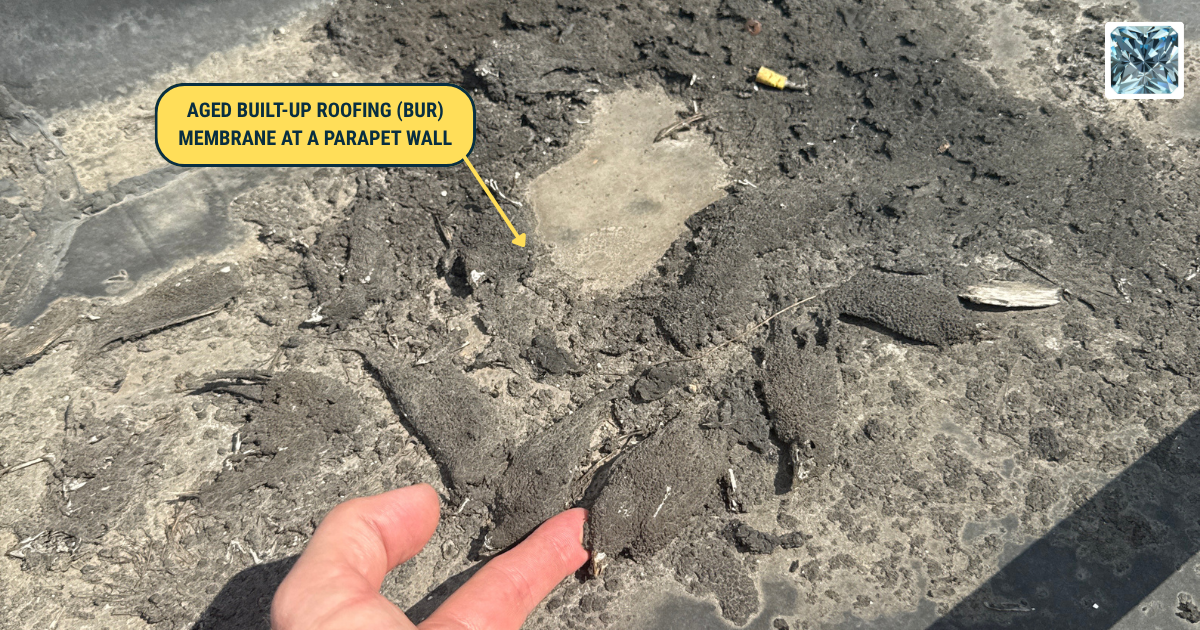
Tar roofs can last 20 to 30 years. But when they go, they go dramatically.
Blistering. Cracking. And when it leaks, finding where is a multi-day archaeology project.
Unless you have a moisture meter and an infrared camera. We do.

Rubber Came Second
In the 1960s and 70s, rubber hit the market. Flexible. Easy to install. Lightweight.
The material is called EPDM, which stands for ethylene propylene diene monomer.
Say that five times fast. Or just call it rubber. That is what it is.
Tommy on the drive home: "So my warehouse has a giant rubber band over the top?"
Pretty much, Tommy. A giant flat rubber sheet, glued at the seams, stretched across the whole building.
That is a good analogy. And here is the problem with rubber bands.
They eventually snap.
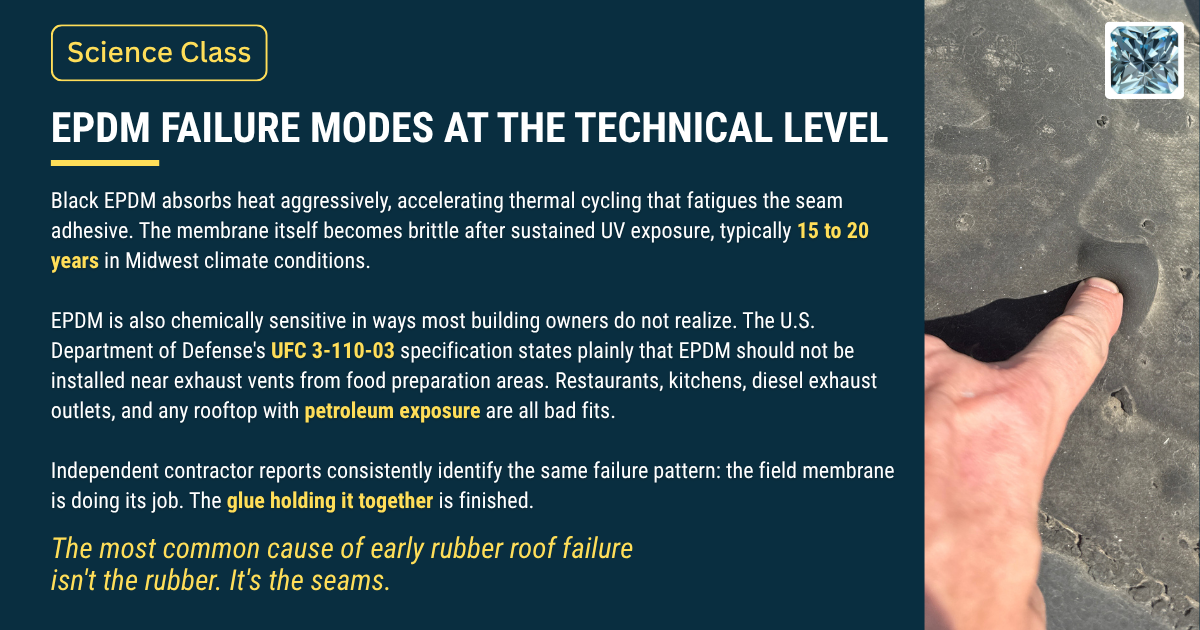
Legacy EPDM rubber shrinks over time, about 1 to 3 percent over its lifespan.
On a 200-foot-wide building, that is two to six feet of rubber pulling away from the walls.
The seams are held together with adhesive. The glue expires.
The field rubber might still look fine. But the edge-glue gave out two winters ago.
Most rubber roof leaks happen at the perimeter and around pipes and vents.
The field is not the problem. The glue is.
Tommy's next question on the drive home, "Why did anyone glue a giant rubber sheet on a building if glue was going to expire?"
Honest answer, Tommy: in the 1970s, it seemed like a great idea.
Rubber was a huge upgrade from hot tar and a leaking gravel cake. It was light. It was fast to install. And the glue back then was supposed to last a lifetime.
Then the 1990s came. And the early rubber roofs from the 1970s started leaking at the seams. Right on schedule, about 20 years in.
The manufacturers fixed the glue. The new glue was better. The rubber from the 1990s lasted longer than the rubber from the 1970s.
But the basic problem never went away. Glue, no matter how good, has a shorter lifespan than the rubber it is holding together.
Which means every rubber roof has a clock built into it. The clock is the glue. When the glue ticks down, the roof leaks.
The rubber itself can still look brand new.
Plastic Showed Up, and Got Very Popular Very Fast
In the late 1990s, a new material swept the commercial roofing industry.
TPO, thermoplastic polyolefin.
Translation: plastic.
Tommy on the drive home: "My warehouse has a plastic roof?"
If your building was constructed after 1998, there is roughly a 40 percent chance the answer is yes, Tommy.
Brittle plastic membranes got popular for three reasons:
- Cheap. Lower upfront cost than rubber or PVC.
- White. Reflects sunlight, which lowers cooling bills compared to black rubber.
- Heat-welded seams. Stronger in theory than glued rubber seams. Sometimes stronger in practice. Sometimes not.
Three good reasons. So what went wrong?
Here is what manufacturers do not put on the brochure.
Tommy on the drive home: "If they weld the seams with heat, why would the seams leak?"
Great question, Tommy. The weld looks fused on the surface even when the chemistry didn't actually bond underneath.
Too low a temperature, the membrane sticks but doesn't truly melt together. That is called a cold weld. Looks perfect. Fails in three to five years.
Too high a temperature, the membrane burns and becomes brittle right where it is supposed to be strongest. Also fails fast.
Nobody can tell the difference from the ground. The roof looks great the day it is installed. The roof looks great a year later. The roof starts leaking around year three to five, and now somebody has to climb up there with a probe and find every bad weld inch by inch.
Independent contractors report that seam failure accounts for roughly 80 percent of all TPO roof leak repairs.
That is not a marketing claim from a competing material. That is field data from independent roofers who climb these roofs every week.
What the U.S. Department of Defense Actually Says About Plastic Roofs
The Department of Defense is the single largest building owner in the United States.
The DoD owns warehouses, hangars, barracks, headquarters buildings, training centers, and command facilities by the thousand.
The DoD does not manufacture roofing materials. The DoD has no financial interest in any single-ply brand.
The DoD's only interest is the lowest lifecycle cost across every square foot of flat roof it owns.
In Unified Facilities Criteria 3-110-03, the federal specification that governs every military roofing project, last updated in June 2020, the DoD says this about plastic TPO roofs:
"Thermoplastic Polyolefin (TPO) shall only be allowed on roofs with an anticipated life of 10 years or less."
— U.S. Department of Defense, UFC 3-110-03 (Change 5, June 2020)
Read that twice.
The federal government, the largest property owner in America, formally restricts plastic TPO to buildings expected to last a decade or less.
Not a long-term roof. Not a 30-year solution. A short-term roof on short-term buildings.
And in the same document, on PVC vinyl, the DoD says:
"Of all weldable thermoplastics, PVC systems have the longest time in service."
— U.S. Department of Defense, UFC 3-110-03
The DoD prefers PVC vinyl. The DoD restricts plastic TPO. The DoD's spec also forbids mechanically fastened TPO entirely. That is not Pristine's opinion. That is federal facility policy, in writing, in the public record, since 2020.

The Three Old Guys, Side by Side
Tar. Rubber. Plastic. Three eras of flat roofing. Each one shaped by what was possible at the time. Each one carrying a different failure mode.

Notice the pattern. Every one of the three old guys fails at the same kind of place, wherever two materials meet. Seam glue expires. Seam welds crack. Tar layers separate. The membrane in the middle of the roof is rarely the problem. The places where one piece had to be joined to another piece, that is where roofs leak.
Article 4 is going to be about exactly that question: every place two materials meet, you have a future leak.
What Your Roof Is Trying to Tell You Right Now
You do not need to climb the roof to figure out what is on it.
Most of the answers are visible from the parking lot.
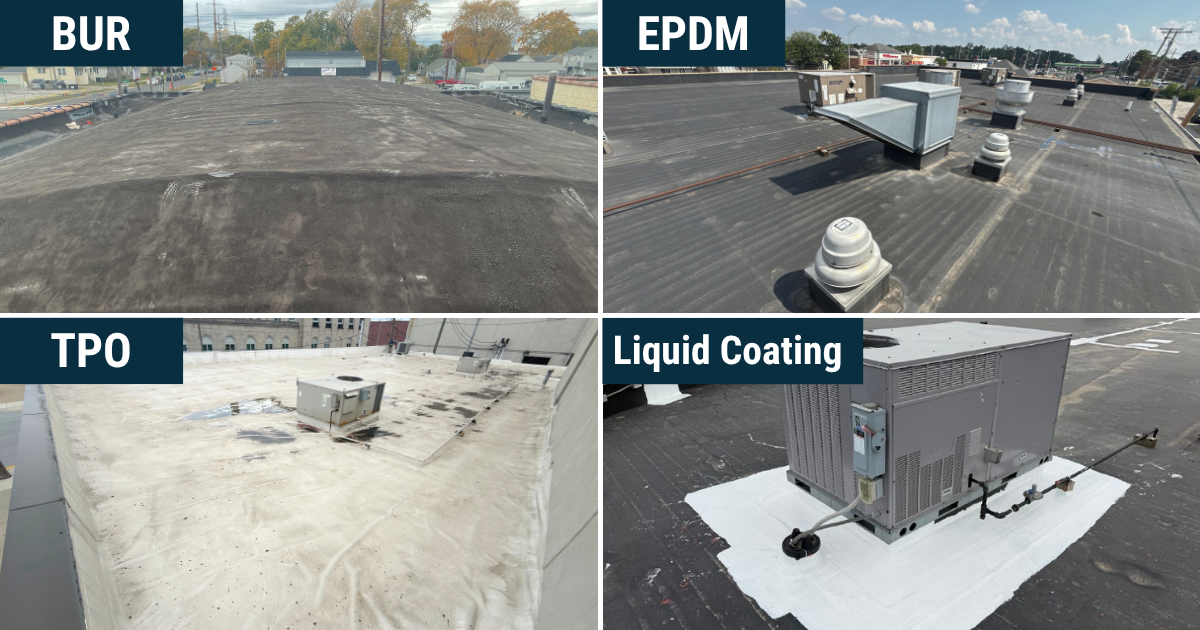
- Black surface with gravel on top? That is tar and gravel, built-up roofing (BUR). 1940s through 1990s vintage. Heavy. Probably original to the building if the building is more than 30 years old.
- Black smooth rubber surface, no gravel? That is EPDM. 1980s through today. Look at the seams, if you see lines every 10 feet running across the roof, those are seam tape locations. That is where it will fail first.
- White rolled membrane with welded seams every 8 to 10 feet? That is TPO. Late 1990s through today. The federal government says it is good for 10 years. Believe them.
- Bright white seamless coating with no rolled lines visible? That is liquid roofing, probably already a Conklin system. Lucky you. Article 3 explains the chemistry.
- Standing-seam metal panels? That is a metal roof. Different category entirely. We cover that in Article 4.
If you don't know what is on your roof, the answer is: you have not looked at it in a while. That is also a finding. Out of sight is out of mind. Out of mind is out of budget. Out of budget is a $60,000 deck repair waiting to happen.
You tried the patches. How are those holding up?
Three years of patches is three years of deferred truth. Let Pristine Industrial Roofing walk your roof, map the moisture, and give you a written assessment, no tear-off pitch, no pressure. Just options. In writing. That you can file away until the budget is ready.
Call or text: (219) 529-1995 • PristineIndustrialRoofing.com • Serving Lake County, Porter County, and Southwest Michigan.
Next: Article 3 — What Is Liquid Roofing and How Does It Actually Cure?
SOURCES CITED
U.S. Department of Defense. Unified Facilities Criteria 3-110-03, Roofing. 1 May 2012, with Change 5 dated 12 June 2020. Section 2-8.5, Thermoplastic Polyolefin (TPO). Approved for public release.
Sika Sarnafil. "PVC vs. TPO" technical bulletin, citing Johns Manville's Dr. Kimberly Deaton-Tokarski RCI workshop presentation on TPO premature failure and reformulation history.
Parsons Roofing. Independent contractor reporting on EPDM roof failure modes, seam adhesion, shrinkage, perimeter detachment.
Northway Roofing (Santa Fe, NM). Independent contractor field documentation: seam failure accounts for approximately 80% of TPO roof leak repairs performed in their service area.
Roofers Coffee Shop. Independent industry discussion forum. Contractor testimony on TPO field failures including delamination, seam separation, hairline fracturing, and UV degradation.
National Roofing Contractors Association (NRCA). NRCA Roofing Manual, current editions. Market share data on flat roofing systems.
PRISTINE INDUSTRIAL ROOFING
Lake & Porter Counties, Northwest Indiana • Southwest Michigan
(219) 529-1995 • BigRoofLibrary.com • ModernRoofChemistry.com
A Gospel Business — Profits Fund Worldwide Missions and Community Outreach
Read other blog:


We Love Conversations
 SoHelpful@PristineIndustrialRoofing.com